Why Petrol cannot be Sold in Nigeria Same Price as in America
How petrol price can be lower in Nigeria than America’s in nominal naira terms and still be far less affordable to the average Nigerian

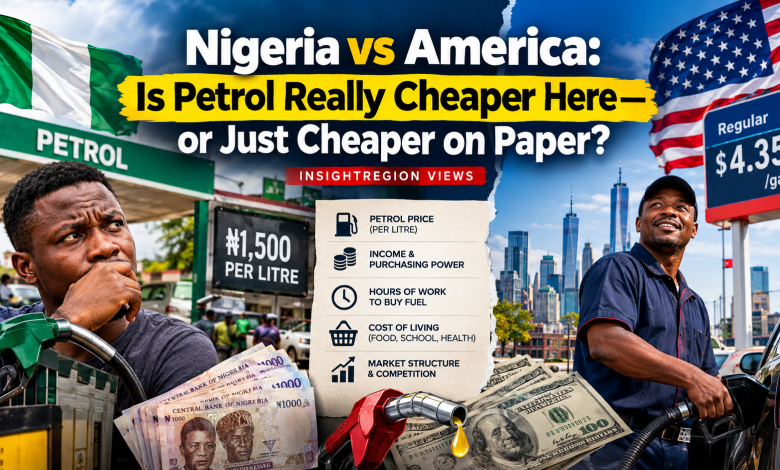
A government comparison says Nigerians are paying less for petrol than Americans. But critics say the calculation leaves out the one thing that matters most to households: how much of their income it takes to buy a litre.
On September 22, 2026, Minister of State for Petroleum Resources (Oil), Heineken Lokpobiri, argued during an appearance on Politics Today that petrol was cheaper in Nigeria than in the United States. Reports quoted him as putting Nigeria’s average around ₦1,430/litre against approximately ₦1,633/litre in the U.S.
That comparison generated criticism, particularly over the fact that nominal pump price does not tell the whole story about affordability. Paul Ibe, for example, challenged the comparison on the grounds that Nigerian income and purchasing power need to be considered.
The argument is not necessarily that the minister’s arithmetic is impossible. The question is whether the arithmetic tells Nigerians what they actually need to know.
When Nigerians complain about the price of petrol, the argument is often met with a comparison that sounds simple: Petrol is not necessarily more expensive in Nigeria than in America or International Market.
On the surface, the numbers can support that argument. But there is another question that a price comparison alone cannot answer: How affordable is that litre to the person buying it?
That is where the debate becomes much more complicated.
The numbers can look surprisingly similar
Nigeria’s petrol prices have moved to around ₦1,400–₦1,500 per litre in many locations.
According to the United States Energy Information Administration, the national average for regular gasoline was about $4.35 per gallon in early October 2026, according to the U.S.


One U.S. gallon is about 3.785 litres.
That means:
$4.35 ÷ 3.785 ≈ $1.15 per litre.
At an exchange rate of roughly ₦1,330 to the dollar:
$1.15 × ₦1,330 ≈ ₦1,530 per litre.
So, at this particular exchange rate, a Nigerian paying about ₦1,500 for a litre is paying an amount that is remarkably close to the U.S. national average when the American price is converted into naira.
That part of the comparison is real. But it is only the beginning of the story.
A litre does not cost the same amount of work
Suppose two people pay the equivalent of ₦1,500 for a litre of petrol. Does that mean the economic burden is the same?
Not necessarily. This is because the price of an item is only one side of affordability. The other side is income.
Nigeria’s national minimum wage is ₦70,000 per month. At ₦1,500 per litre, that entire monthly wage would buy approximately:
₦70,000 ÷ ₦1,500 = 46.7 litres.
In other words, someone earning the statutory ₦70,000 monthly minimum wage would need to spend roughly 2.1% of their entire monthly salary for every litre of petrol.
The United States provides a useful contrast, but it must be handled carefully.
The federal minimum wage remains $7.25 per hour, although many states have minimum wages above that level. In Texas, for example, the federal rate applies to covered workers.
At roughly $1.15 per litre, a worker earning the federal minimum wage could theoretically earn enough in about 10 minutes of work to buy a litre of petrol, before taxes and other deductions.
That does not mean every American worker enjoys that wage or that Americans generally spend less on fuel. It simply illustrates why the same nominal price can impose very different burdens on people with very different incomes.
And that is the part of the debate that gets lost when countries are compared only by pump price.
The World Bank itself has noted that Nigeria’s reforms toward market-based gasoline pricing have produced substantial short-term pressure on households and firms, while stressing the need to protect poorer households from purchasing-power losses.
So, is Nigerian petrol actually cheaper?
The answer depends on what we mean by “cheaper.”
If we mean the price converted into U.S. dollars, Nigerian petrol can be cheaper than the American national average.
If we mean the amount of income an ordinary worker must sacrifice to buy it, the picture changes considerably.
This distinction is important. A product can be cheap compared with another country and still be unaffordable to the people who need it.
That is why telling a Nigerian worker that petrol is cheaper here than in America may not resolve the frustration at the filling station.
The worker is not paid an American salary.
Why can’t Nigeria simply sell petrol at a much lower price?
This is where another part of the debate needs to be understood. Nigeria produces crude oil, but producing crude does not automatically mean producing petrol cheaply.
Petrol is a refined petroleum product.
Between crude oil and the litre that enters a vehicle’s tank are costs associated with crude supply, refining, transportation, storage, distribution, financing, exchange rates and retail operations.
And because petroleum is traded internationally, global oil and refined-product prices influence the economics of the Nigerian market.
The exchange rate matters too.
If a significant part of the cost structure is effectively linked to dollars while consumers earn mostly in naira, a weaker naira can translate into higher domestic petroleum costs.
This is one reason the removal of petrol subsidies fundamentally changed the Nigerian market. Instead of the government absorbing a large part of the difference between market costs and the pump price, consumers became much more exposed to movements in the market.
The argument for this system is straightforward: it reduces the enormous fiscal burden associated with subsidising consumption and allows prices to reflect market conditions.
The argument against looking at the issue only through that lens is equally straightforward: What happens to households whose incomes do not rise with the cost of living?
Producing oil does not automatically make petrol cheap
There is a common assumption that Nigeria should have extremely cheap petrol because Nigeria is an oil-producing country.
But crude oil and petrol are not the same product.
Nigeria can produce crude while still facing problems involving domestic crude availability, refinery capacity, logistics, financing, exchange rates and competition in the downstream market.
The emergence of large-scale domestic refining, particularly the Dangote refinery, has changed the structure of the market. But domestic refining does not eliminate every international cost.
In July 2026, Reuters reported that Dangote Refinery began pricing local fuel sales in dollars, citing difficulties securing sufficient domestic crude supplies and the need to source crude internationally.
That development illustrates an important point: Having a refinery inside Nigeria does not automatically disconnect Nigerian petrol prices from the international oil market.
But there is another question Nigerians are entitled to ask
If petrol is now largely market-priced, Nigerians can reasonably ask:
How competitive is that market?
Competition matters because a market with multiple credible suppliers should, in theory, put pressure on sellers to compete for customers.
This is why the World Bank’s recent discussion of Nigeria’s downstream petroleum market is significant. It has raised concerns about competition and recommended measures aimed at increasing competition in the PMS market, including reopening access to qualified importers under appropriate conditions.
That does not mean imports are automatically the answer. It means that the structure of the market matters just as much as the headline price.
The real Nigerian problem may be bigger than petrol
For millions of Nigerians, petrol is not simply another household expense. It affects almost everything.
- A commercial driver pays more to operate.
- A farmer pays more to transport inputs and produce.
- A trader pays more to move goods.
- A manufacturer faces higher logistics and energy costs.
- A worker who drives to work spends more getting there.
- A business owner eventually passes some of those costs into the price of goods and services.
So when petrol rises, the effect does not necessarily end at the filling station. It can move through the economy.
That is why the argument over petrol affordability is also an argument about transport, food prices, business costs and household purchasing power.
This is where the American comparison falls short
Saying that petrol costs roughly the same in Nigeria and America after currency conversion may be useful. But it does not tell us whether Nigerians can afford the same amount of petrol.
Imagine two people buying a bottle of water for the same price.
One earns ₦70,000 a month.
The other earns an income many times higher.
The price on the shelf is the same. The economic sacrifice is not. That is the distinction Nigerians are making when they react angrily to comparisons with America.
They are not necessarily disputing the arithmetic. They are questioning whether international price comparisons without income comparisons tell the whole story.
Nigeria’s national minimum wage was raised to ₦70,000 in 2024, but labour leaders are still calling for another review in 2026, arguing that inflation and rising living costs had eroded workers’ purchasing power. The NLC describes the ₦70,000 as inadequate in August 2026.
So, what does a cheaper litre mean if the worker’s income buys dramatically less of it?
The better comparison
Perhaps Nigeria should stop asking only: “Is our petrol cheaper than America’s?”
But ask several questions at the same time:
- How much does a litre cost?
- How much does the average worker earn?
- How many hours of work are required to buy a litre?
- How much of a household’s monthly income goes to transportation?
- How competitive is the petroleum market?
- And what happens to food and other essential prices when fuel becomes more expensive?
Those questions provide a much clearer picture of affordability.
Cheaper on paper, expensive in real life?
There is no contradiction in saying that Nigerian petrol may be cheaper than American petrol when both prices are converted into the same currency, while also saying that petrol can be much harder for many Nigerians to afford. Both can be true.
The first is a price comparison. The second is a living-cost comparison.
And for the Nigerian worker standing at a filling station with ₦2,000 in hand, the second question may be the one that matters most.
The debate, therefore, should not simply be about whether Nigeria’s petrol price is higher or lower than America’s.
It should be about whether the price is sustainable for households, businesses and the wider economy relative to what Nigerians earn. Because a litre can be cheaper on paper and still feel painfully expensive in real life.
What do you think?
Should Nigeria judge petrol affordability mainly by international market prices, by Nigerian incomes and purchasing power, or by both?
Share your view with InsightRegion.