Student Venture Capital Grant 2026: How Nigerian Students Can Apply for Up to ₦50 Million

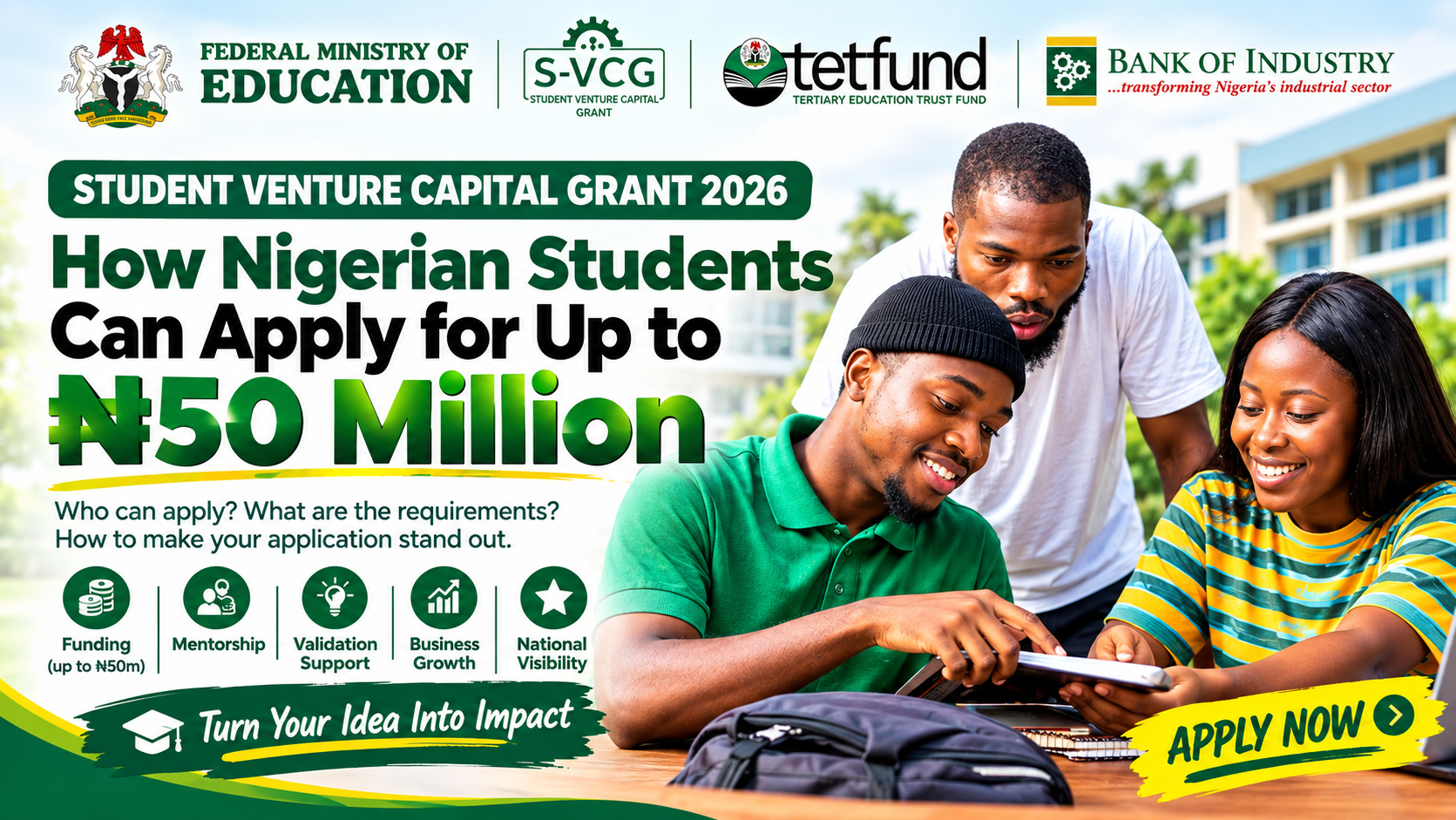
Have you built a business, technology product or other innovative solution while in school? The Federal Government has opened applications for the second Student Venture Capital Grant, with 50 student-led ventures eligible for up to ₦50 million each in equity-free funding. Here is what Nigerian students need to know before applying.
Sometimes, a business starts in a university hostel. Sometimes, it begins as a project in a laboratory, a prototype built after lectures, a software application created by a group of students, or an attempt to solve a problem that everyone on campus has simply learned to live with.
But having an idea is one thing. Turning that idea into something people can actually use, buy or benefit from is another. That is where the Federal Government’s Student Venture Capital Grant (S-VCG) comes in.
The second cohort of the programme is now accepting applications from student entrepreneurs across Nigeria. The initiative aims to select 50 outstanding student-led ventures, with each successful venture eligible for up to ₦50 million in equity-free funding to develop and scale its business.
That sounds like a straightforward grant opportunity.
It isn’t quite that simple.
The programme is not designed for every student with a business idea. The official S-VCG platform sets specific eligibility requirements, including academic level, CAC registration and the stage of development of the venture. It also expects applicants to demonstrate that their projects have potential beyond an idea on paper.
So before you start thinking about what you would do with ₦50 million, the more important question is: Is your venture ready for this opportunity?
What Is the Student Venture Capital Grant?
The Student Venture Capital Grant, or S-VCG, is a Federal Ministry of Education initiative designed to support student-led businesses and innovations in Nigeria. The programme is also known as the Next Moonshot Initiative.




Its purpose goes beyond simply giving students money. The official programme describes S-VCG as providing funding alongside validation support, mentorship, tools and national visibility for student-led businesses.
For the current cycle, the government is looking for 50 student-led ventures that can demonstrate strong potential. Successful ventures can receive up to ₦50 million in equity-free funding.
That means the funding is intended to help qualifying ventures develop and grow without requiring the student founders to surrender ownership of their businesses in exchange for the grant.
The programme is particularly focused on innovations connected to Science, Technology, Engineering, Mathematics and Medical Sciences (STEMM).
Who Can Apply for the ₦50 Million Student Grant?
This is probably the first thing you should check. According to the official S-VCG platform, you can apply if you are currently enrolled in a Nigerian tertiary institution, including:
- Universities
- Polytechnics
- Colleges of education
- Students from both public and private tertiary institutions are eligible.
However, there is an important academic-level requirement.
You generally need to be in 300 level or above
The programme says an applicant must be at least in 300 level or its equivalent. But that does not mean students in 100 or 200 level are completely excluded.
Students below 300 level can participate as members of a team led by a qualifying student in 300 level or above. The younger student should be included as a co-founder or partner in the submission.
So, for example, a 200-level computer science student who has helped develop a technology venture does not necessarily have to wait until graduation.
They could participate as part of an eligible team led by a qualifying senior student.
Do You Need a Registered Business?
Yes. This is one of the requirements students should pay particular attention to.
The official S-VCG FAQ states that the project or innovation must have a business name or company registered with the Corporate Affairs Commission (CAC) in Nigeria.
That means having an interesting school project is not automatically enough. If your venture is not properly registered, you should investigate the registration requirement before preparing your application.
This is also why students should avoid waiting until the final day before beginning the application process.
Can You Apply With Just a Business Idea?
This is where many potential applicants could misunderstand the opportunity.
Not every idea is ready for S-VCG.
The official programme specifically says applicants cannot simply submit an undeveloped idea or basic concept. The project or business must be beyond the proof-of-concept stage and sufficiently developed to demonstrate real-world potential.
Think about it this way.
An early idea
“I want to create an app that helps farmers sell their produce directly to consumers.” That may be an interesting concept. But it doesn’t necessarily demonstrate that the venture is ready.
A more developed venture
“We have developed the first version of the platform, tested it with farmers in two communities, identified our first group of users and discovered specific problems we need funding to solve.” That is much stronger.
The difference is evidence.
The S-VCG opportunity is therefore better suited to students who have moved beyond: “I have an idea.” towards: “I have built something, tested something or demonstrated that this solution can work.”
What Kind of Student Ventures Are Eligible?
The programme’s focus is STEMM:
Science
This could include scientific innovation, biotechnology, agricultural innovation and other solutions emerging from scientific research.
Technology
Software, artificial intelligence, digital platforms, hardware and other technology-driven solutions.
Engineering
Products, machinery, infrastructure and engineering solutions designed to solve practical problems.
Mathematics
Data-driven solutions, analytical systems, financial modelling and other ventures built around mathematical or quantitative innovation.
Medical Sciences
Healthcare technology, medical devices, health-delivery solutions and other innovations connected to medical science. The official S-VCG platform specifically identifies these five areas as its STEMM focus. But don’t get trapped by the labels.
A student venture could potentially operate in areas such as health, agriculture, education, energy, logistics or e-commerce while incorporating STEMM-based innovation. Recent government communications about the second cohort specifically highlighted these areas.
The important question is not simply: “Is my business in technology?”
Instead ask: “What problem does my venture solve, how does it solve it, and what makes the solution innovative and scalable?”
What Does the Government Actually Want to See?
This is probably the most important question for an applicant. The opportunity is not really about finding students who can write the most impressive business description. It is about identifying ventures with enough potential to justify further support.
A strong application should make several things clear.
1. What problem are you solving?
Don’t start with your product. Start with the problem. Who experiences it? How serious is it?How frequently does it happen? and What does it cost people or businesses?
2. What have you built?
Explain the actual solution. Is there: a working product? A platform? A prototype? A service? A device? A tested process?
Show the difference between what exists today and what you intend to build.
3. What evidence do you have?
This could be:
- Users
- Customers
- Revenue
- Pilot projects
- Prototype testing
- Partnerships
- User feedback
- Research
- Demonstrated results
- Growth
- Successful experiments
- Evidence gives your application credibility.
4. Who needs your solution?
A venture needs more than a good product. It needs people who actually need that product. Explain who your customers or users are and how large the potential market could become.
5. Why is your team capable of building it?
If you’re applying as a team, don’t simply list people’s names. Explain what each person contributes. Perhaps one person handles technology, another business development, another operations and another research.
The strongest teams are built around complementary skills.
The ₦50 Million Question: How Would You Use It?
This is where applicants should be particularly careful. The opportunity is advertised as up to ₦50 million, not an automatic ₦50 million payment to every applicant.
The official platform says S-VCG uses milestone-based funding, with approved teams unlocking funding in tranches as they reach specific milestones.
So don’t approach your application like this: “If I receive ₦50 million, I will use it to expand my company.” That’s too vague.
Instead, think:
Funding → Activity → Milestone → Result
For example:
Product development
→ Complete the next version of the product
→ Launch to 1,000 users
→ Measure adoption and retention
Or:
Equipment
→ Acquire production equipment
→ Increase production capacity
→ Serve a defined number of customers
Or:
Market expansion
→ Enter three additional locations
→ Acquire a specific number of customers
→ Generate measurable revenue
The more clearly you can connect funding to measurable progress, the easier it becomes for someone evaluating your venture to understand why additional capital could make a difference.
What You Should Prepare Before Applying
The official programme portal says applicants need a business plan containing expenditure milestones and key performance indicators (KPIs).
That means you should not begin your application by opening the portal and hoping to figure everything out as you go. Prepare first.
Your venture information
Have a clear explanation of:
- What your business does
- What problem it solves
- Who it serves
- How it works
- What makes it different
- How far it has developed
Your evidence
Prepare whatever demonstrates progress, such as:
- Product demonstrations
- Prototype
- Customer numbers
- Revenue figures
- Pilot results
- User feedback
- Partnerships
- Market research
Your business plan
Your plan should explain:
- Business model
- Market
- Competition
- Growth strategy
- Funding requirements
- Expenditure milestones
- KPIs
Your team information
Be ready to explain:
- Who the founders are
- Their roles
- Relevant skills
- Their contribution to the venture
Don’t Tell the Judges What You Hope to Build. Show Them What You Have Built.
This is one of the biggest lessons prospective applicants should take from the opportunity. Compare these two statements.
Weak approach
“With ₦50 million, we will develop a revolutionary artificial intelligence platform that will transform education in Nigeria.” It sounds ambitious. But it doesn’t demonstrate much.
Stronger approach
“We have built and tested the first version of our platform with 500 students across three institutions. Our testing showed that students struggled most with X. The next stage of development requires Y, which would allow us to expand the pilot to Z institutions.”
The second approach provides:
Evidence → Problem → Learning → Funding Need → Next Step
That is the kind of thinking student entrepreneurs should bring to this opportunity.
You Don’t Have to Be a Finished Company
There is an important balance here. S-VCG is not asking student entrepreneurs to have already built a giant company. But it is also not looking for ideas that exist only in someone’s notebook.
The official requirement that ventures be beyond proof of concept sits somewhere between those two extremes. You don’t necessarily need:
- A huge workforce
- Millions of naira in revenue
- Thousands of customers
- A nationally recognised brand
But you should be able to demonstrate that your venture is real enough to evaluate and has meaningful potential to grow.
What Happens After You Apply?
Submitting your application is not the end of the process. The second cohort is using a multi-stage selection process.
Government officials said applications will undergo AI-assisted screening, followed by assessment by 10 human evaluators. Shortlisted applicants will then make virtual presentations before an evaluation committee, while finalists will proceed to a boot camp and in-person presentation.
That means your application should be prepared with the possibility that you may eventually need to explain and defend your venture in person.
- Know your numbers.
- Know your customers.
- Know your market.
- Know your product.
And, most importantly, know exactly what additional funding would help you accomplish.
What Do Successful Student Ventures Get?
The headline benefit is obviously the funding. But the programme is offering more than money.
The official S-VCG platform says the programme combines:
- Funding
- Validation support
- Mentorship
- Tools
- National visibility
- Innovation ecosystem exposure
For the second cohort, the government has also announced a six-month mentorship programme involving experienced organisations and business leaders from sectors including technology, logistics, e-commerce, health and education.
That could be particularly valuable for students who have technical skills but limited experience running a growing business. Money can help you build a product. The right mentorship can help you understand how to build the company around it.
How Competitive Is the Opportunity?
This is another reason students should take the application seriously.
The first S-VCG cycle attracted 17,914 registrations from 404 tertiary institutions across Nigeria, according to the National Project Coordinator. After completed applications went through screening and evaluation, 65 finalists reached the boot camp and 45 ventures were eventually selected as beneficiaries.
The second cohort is targeting only 50 ventures. That doesn’t mean you shouldn’t apply. It means you should not treat the application like a routine grant form.
If thousands of students are competing for a limited number of places, the question becomes: What makes your venture worth selecting? Your answer should be visible throughout your application.
A Simple Framework for Building Your Application
If you are struggling to organise your story, use this framework:
Problem → People → Solution → Evidence → Team → Growth → Funding
- Problem – What specific problem are you solving?
- People – Who experiences the problem?
- Solution – What have you built to solve it?
- Evidence – What have you learned from real users, customers or testing?
- Team – Why are you and your co-founders capable of executing?
- Growth – What could the venture become if it succeeds?
- Funding – What specifically would additional funding allow you to accomplish?
If you can answer all seven clearly, you have a much stronger foundation for your application.
Common Mistakes Student Applicants Should Avoid
Mistake 1: Applying with only an idea. The official programme requires the venture to have progressed beyond proof of concept.
Mistake 2: Focusing only on the ₦50 million. The money is not the business. Explain what the funding will accomplish.
Mistake 3: Using impressive words without evidence. “Revolutionary.” “World-changing.” “Disruptive.” “Game-changing.” These words mean little without proof.
Mistake 4: Asking for money without a milestone. Explain what happens after the funding.
Mistake 5: Ignoring CAC registration. Make sure you understand and satisfy the registration requirement.
Mistake 6: Leaving the application until the deadline. Documents, business plans and team information take time.
Mistake 7: Inventing numbers. Don’t exaggerate users, revenue, customers or market size. A smaller number that you can prove is more valuable than a huge number you cannot defend.
What If You Are a 100- or 200-Level Student?
Don’t automatically give up. The official rules allow students below 300 level to participate as members of teams led by eligible students in 300 level or above.
If you have the technical expertise, product idea or other valuable contribution, look for an appropriate team structure that satisfies the programme’s requirements.
The important thing is to build a real team around a real venture, rather than adding people simply to satisfy an application requirement.
The Application Deadline Is September 30, 2026
Applications for the second cohort are open until September 30, 2026.
The government is also running a nationwide campus mobilisation campaign during September to increase awareness and help students understand the programme. The campaign is scheduled to reach nine tertiary institutions across Nigeria’s six geopolitical zones, with a Campus Ambassador Programme extending awareness to another 20 institutions.
If you are interested, don’t wait for the final day. Use the time yoy have now to check your eligibility, organise your documents, strengthen your business plan and prepare your evidence.
How to Apply for the Student Venture Capital Grant
Applications are being handled through the official S-VCG platform.
Official Student Venture Capital Grant Portal
The official application portal allows students to register and apply for funding while tracking their projects through the S-VCG platform.
Before submitting, make sure you have checked:
- Your student eligibility
- Academic level requirement
- CAC registration
- STEMM relevance
- Proof-of-concept/development stage
- Business plan
- Expenditure milestones
- KPIs
- Team information
- Funding requirement
For questions about the programme, you can contact the official S-VCG through support.svcg@education.gov.ng
Quick Eligibility Check
Before you apply, ask yourself:
- Are you currently enrolled in a Nigerian university, polytechnic or college of education?
- Are you at least 300 level or equivalent—or participating in an eligible team led by someone who is?
- Is your venture connected to STEMM or an appropriate STEMM-related application?
- Is your business registered with CAC?
- Has your venture progressed beyond a basic proof of concept?
- Can you demonstrate real-world potential?
- Do you have a business plan?
- Can you explain your expenditure milestones and KPIs?
- Can you show evidence that people need your solution?
If your answer is yes across these areas, this opportunity may be worth serious consideration.
Should You Apply?
If you have a qualifying student-led venture that is already beyond the idea stage, yes—this is an opportunity worth exploring seriously.
But don’t apply simply because you saw the words “₦50 million grant.” Apply because you have something worth building.
The strongest reason to apply is not: “I need money for my business.”
It is: “I have identified a real problem, built a solution, learned from the market and know exactly what additional support could help me take the venture to its next stage.”
That is a much more compelling proposition.
InsightRegion’s Take
The most interesting part of the Student Venture Capital Grant may not actually be the ₦50 million. It is the idea behind it.
Nigeria has millions of students studying across universities, polytechnics and colleges. Some of them will graduate looking for jobs. Others may graduate having already created something that can employ people.
The S-VCG is attempting to identify some of the latter.
For students considering the opportunity, the biggest lesson is therefore simple: Don’t build your application around the money. Build it around the venture.
- Show the problem.
- Show the solution.
- Show what you have learned.
- Show the people who need it.
- Show why your team can execute.
Then show how funding can move the venture from where it is today to where it could realistically go next.
Because the question isn’t really: “What would you do with ₦50 million?”
The better question is: “What have you already built—and what could you achieve if you had the resources to take it further?”
That is the question worth answering.
InsightRegion — Where Information Meets Insight.