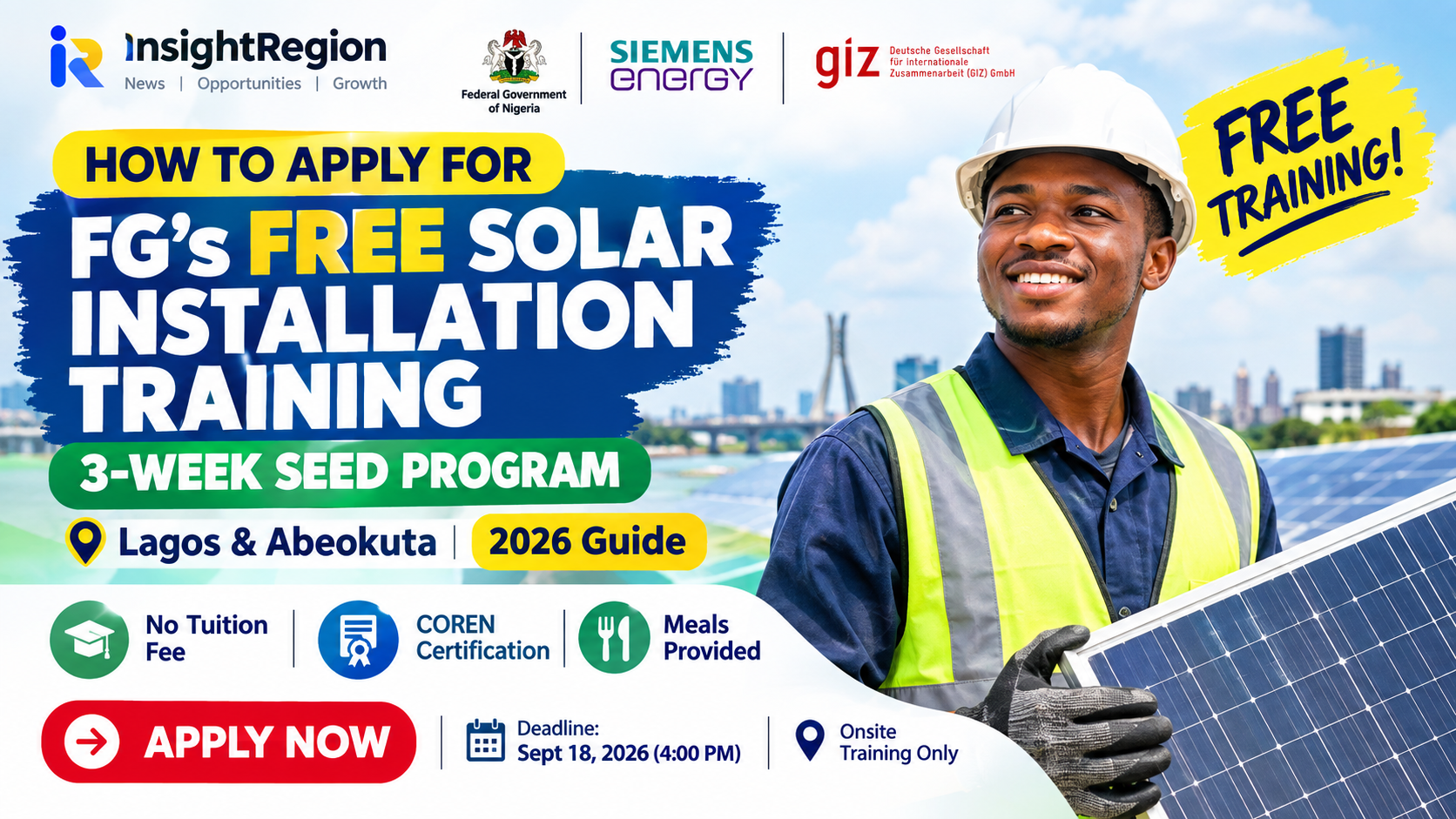
Applications are open for the Siemens Energy Education and Development (SEED) Solar PV Installation Training in Nigeria. Here is who can apply, what is free, where the training will take place, what you will learn, and how to submit your application.
If you are looking for a practical skill that can open doors in Nigeria’s growing renewable energy sector, the Federal Government’s new SEED Solar PV Installation Training could be worth considering.
The programme is offering three weeks of intensive, in-person solar photovoltaic (PV) installation training, combining classroom instruction with practical training, technical site visits and competency assessments.
The initiative is being delivered under the Siemens Energy Education and Development (SEED) project, with support from the Nigerian Energy Support Programme (NESP) and collaboration involving Siemens Energy, GIZ, FGN Power Company and the Federal Ministry of Power. GIZ says SEED is part of a wider effort to develop Nigeria’s energy workforce as investment in the country’s power infrastructure expands.
For successful participants, training and certification are free, while meals will be provided during training days. However, you should budget for your own transportation and accommodation because these are not provided by the organisers.
This guide explains everything you need to know before applying.
SEED Solar PV Installation Training 2026: Quick Facts
| Detail | Information |
| Programme | Siemens Energy Education and Development (SEED) |
| Training | Solar PV Installation (SPVI) |
| Duration | 3 weeks |
| Format | Onsite/in-person |
| Locations | Abeokuta, Ogun State and Lagos |
| Training cost | Free |
| Certification cost | Free |
| Meals | Provided during training days |
| Accommodation | Not provided |
| Transportation | Not provided |
| Application | Online Expression of Interest |
| Deadline currently reported | September 18, 2026, 4:00 PM |
| Enquiries | nesp@giz.de |
The current public announcement says applications close at 4:00 PM on Friday, September 18, 2026. However, a GIZ-linked repost currently shows September 15, so applicants should submit as early as possible rather than waiting for the final day.
What Is the SEED Solar PV Installation Training?
SEED stands for Siemens Energy Education and Development. It is a capacity-development initiative designed to help build a stronger pool of skilled energy professionals in Nigeria.



The project is connected to the Nigerian Energy Support Programme (NESP), a technical assistance programme co-funded by the European Union and the German Government and implemented by GIZ in collaboration with Nigeria’s Federal Ministry of Power.
The wider SEED initiative is expected to train thousands of energy professionals in Nigeria over the coming years, including young people and women, with certification aligned with Nigerian, ECOWAS and European standards.
The current opportunity focuses specifically on Solar Photovoltaic Installation (SPVI). That makes it particularly relevant to people who want to work in areas such as:
- Solar PV installation
- Renewable energy
- Electrical and technical services
- Solar system maintenance
- Energy infrastructure
- Mini-grid and distributed energy projects
- Other emerging clean-energy opportunities
The programme is intended to strengthen both the technical knowledge and practical skills needed by people working, or hoping to work, in Nigeria’s renewable-energy sector.
What Will You Learn During the 3-Week Solar Training?
This is not simply an online course where you watch videos and receive a certificate. The training is designed around a combination of theory, practical work, technical site visits and competency assessment. Participants can therefore expect exposure to areas relevant to actual solar PV installation and energy work.
The programme includes:
1. Theoretical instruction
You will learn the technical principles behind solar photovoltaic systems and their application.
2. Hands-on practical training
The practical component is particularly important for anyone hoping to work as a solar technician or installer. Instead of learning only from textbooks, participants get an opportunity to develop practical technical competence.
3. Technical site visits
Participants will also be exposed to real-world energy installations through technical site visits. This can help connect classroom knowledge with how renewable-energy systems operate in practice.
4. Competency assessments
Your knowledge and practical understanding will be assessed during the programme.
5. Certification
Successful participants will receive certification associated with the programme, with current announcements specifically stating that COREN certification is provided upon successful completion.
Important: Receiving a training/certification credential should not be confused with automatically becoming a registered professional engineer under COREN. Applicants should follow the applicable COREN requirements for any separate professional registration they may later seek.
Where Will the Free Solar Training Take Place?
The current opportunity has two training locations.
Stream 1: Abeokuta, Ogun State
Training will take place at the SEED Training Centre in Abeokuta. The first stream is scheduled for September 2026.
Stream 2: Lagos State
The second stream will be held at an NESP Training Partner in Lagos.
Public announcements have given differing descriptions of the timing, with some current listings stating October and others November 2026. Applicants should therefore rely on the location/stream information communicated to shortlisted candidates rather than assuming a particular start date.
Is the training online?
No. This is an onsite, three-week training programme. If you are selected, you need to be able to attend physically for the required training period.
That means you should consider your transportation and accommodation arrangements before selecting a location.
Is the SEED Solar Training Really Free?
Yes, the organisers say the training and certification are free. Meals will also be provided on training days.
However, there is an important distinction between a free training programme and a fully funded opportunity.
The organisers provide:
- Training
- Certification
- Meals during training days
You are responsible for:
Transportation to and from the training location
- Accommodation
- Other personal expenses
GIZ-NESP and Siemens Energy have stated that accommodation and transportation support will not be provided. So if you live outside Lagos or Abeokuta, calculate your likely travel and accommodation costs before applying.
Who Can Apply for the Free Solar PV Training?
One of the most attractive features of this opportunity is that applicants are not restricted to people with university degrees. The programme welcomes people from both formal educational and practical/experience-based backgrounds.
You may be suitable if you fall into one of these groups:
People with practical experience
Individuals with at least two years of practical experience can apply, and formal education is not required for this pathway.
This could make the programme particularly relevant to technicians and people who have developed their skills through practical work.
Recent graduates
Recent graduates with qualifications such as ND, HND, University degrees, are encouraged to apply.
Young professionals
Young professionals working in areas such as:
- Electrical engineering
- Mechanical engineering
- Renewable energy
- Other related technical fields
can also apply.
People interested in renewable energy
The opportunity is also aimed at people who genuinely want to build a career in the renewable-energy sector. This is important because the programme is not presented as an opportunity exclusively for experienced solar installers.
Do You Need a University Degree to Apply?
No, the current eligibility information specifically allows practical/experience-based applicants.
People with at least two years of practical experience can apply without formal educational qualifications, while recent ND, HND and university graduates are also encouraged to apply.
This makes the opportunity potentially useful for electricians, technicians, tradespeople and other technically minded applicants who may not have followed the traditional university route.
How to Apply for FG’s Free Solar Installation Training
The application is made online through an Expression of Interest form.
Here is the process.
Step 1: Open the Application Form
Use the official application form provided for the SEED Solar PV Installation Training.
Apply here: SEED Solar PV Installation Training Application Form
Before submitting personal information, make sure you are using the correct application link. Because fake recruitment and scholarship links are common online, avoid paying anyone who claims they can “secure” a place for you.
Step 2: Enter Your Personal Information
The application requires the following basic personal information:
-
- Full name
- Gender
- Phone number
- Email address
- State of residence
- Preferred training location
- Use an active telephone number and email address.
The organisers need to be able to contact you if you are shortlisted.
Step 3: Select Your Preferred Location
You will need to indicate your preferred training location. The current locations are:
- Abeokuta, Ogun State
- Lagos State
Do not simply choose a location because it sounds more convenient. Think about whether you can actually travel to the centre and attend the programme throughout the training period.
Step 4: Confirm That You Can Attend Physically
The training is onsite. You should therefore only confirm your availability if you can realistically attend the three-week programme. This is particularly important for applicants travelling from another state.
Step 5: Provide Your Education and Work Background
The application asks about your background, and including areas:
- Highest educational qualification
- Employment status
- Work experience
- Sector of employment
If you have practical experience rather than formal education, explain your experience accurately. For example, if you have worked as an electrician or assisted with electrical installations, provide that information where appropriate.
Step 6: Upload Supporting Documents Where Required
Applicants with formal educational qualifications may be asked to provide supporting documents such as a CV, certificates or other relevant credentials. Current media reports based on the application notice indicate that formal-qualification applicants should be prepared to upload their latest CV and relevant certificates.
Have clear copies and scanned copies ready before you begin the application.
Step 7: Submit Your Application Early
Do not wait until the final hour. The deadline currently being reported by the FGN Power Company announcement and multiple Nigerian news outlets is:
Friday, September 18, 2026 at 4:00 PM.
However, because a GIZ-linked repost has displayed September 15, the safest strategy is to submit your application before September 15 if possible.
Note that only successful applicants will be contacted.
What Should You Put in Your Application?
Don’t treat the Expression of Interest form as something to rush through. If you have relevant experience, make it clear.
For example, instead of simply writing: “I am interested in solar energy.”
A stronger explanation would communicate: “I want to develop practical solar PV installation skills so I can build a career in renewable energy and apply those skills to reliable electricity solutions in my community.”
The important thing is to be truthful and specific. Mention relevant experience if you have it, including:
- Electrical work
- Solar installation
- Inverter installation
- Battery systems
- Construction
- Technical maintenance
- Engineering
- Energy-related work
- Apprenticeship or trade experience
Don’t invent experience you don’t have.
7 Practical Tips Before You Apply
1. Apply as early as possible
The application window is short. Don’t build your strategy around the final deadline.
2. Choose the location you can actually attend
Free tuition does not mean free transportation. If you cannot afford regular travel to a centre, consider the location carefully before submitting your preference.
3. Prepare your documents
If you are applying through the formal-education pathway, keep your CV and certificates ready.
4. Use an active email address
Don’t use an email account you rarely check.
5. Keep your phone available
Shortlisted candidates need to be reachable.
6. Be honest about your experience
Whether you have two years of technical experience or you are a recent graduate, give accurate information.
7. Don’t pay anyone for admission
The programme itself is free. Be cautious if anyone asks you to pay a “registration fee,” “slot fee,” “processing fee” or money to guarantee selection.
Will the Free Solar Training Give You a Job?
No job is guaranteed. This is an important point that applicants should understand. The programme is designed to build technical skills and improve the pipeline of industry-ready energy professionals. It can strengthen your CV and practical knowledge, but completing the programme does not constitute a promise of employment.
Your eventual opportunities will depend on your skills, experience, certification, location, networking and the requirements of employers or clients.
For someone serious about renewable energy, however, practical training can be a useful step toward becoming more employable in the sector.
Why Solar PV Skills Could Be Valuable in Nigeria
Nigeria’s electricity challenges have created a large market for alternative and distributed energy solutions.
Solar panels, batteries, inverters, mini-grids and other distributed-energy technologies are becoming increasingly important to homes, businesses and institutions.
At the same time, large investments in Nigeria’s power sector are increasing the need for people with appropriate technical skills.
GIZ has specifically linked the SEED initiative to the need for a qualified local workforce capable of supporting Nigeria’s expanding power infrastructure and the country’s energy transition. That does not mean every trainee will immediately get a high-paying solar job.
But it does mean that acquiring practical, recognised technical skills can be a sensible investment in a sector receiving significant attention.
Frequently Asked Questions About the SEED Solar Training
Is the FG solar installation training free?
Yes. The current programme information states that the training and certification are free, and meals are provided on training days. Participants must cover their own transportation and accommodation.
How long is the SEED solar training?
The training lasts three weeks and is conducted onsite.
Where is the free solar training taking place?
The current programme has training locations in Abeokuta, Ogun State, and Lagos State.
Can someone without a degree apply?
Yes. Applicants with practical experience can apply without formal educational qualifications. Recent ND, HND and university graduates are also eligible categories.
Do I need previous solar installation experience?
Not necessarily. The published eligibility information includes applicants from practical/experience-based backgrounds as well as graduates and people interested in developing careers in renewable energy.
Is the training online?
No. It is a three-week physical/onsite programme.
Will accommodation be provided?
No. Participants are expected to make their own accommodation arrangements.
Will transportation be provided?
No. Participants are responsible for their transportation.
Will meals be provided?
Yes. Meals will be provided during training days.
Will I receive a certificate?
Successful participants are expected to receive certification, with the current programme information specifically referring to COREN certification upon completion.
Does the certificate guarantee employment?
No. The training can strengthen your technical profile, but employment is not guaranteed.
What is the application deadline?
The current FGN Power Company announcement is being reported as 4:00 PM on Friday, September 18, 2026. Because another GIZ-linked repost currently shows September 15, applicants should submit as early as possible.
How can I contact the organisers?
For enquiries, contact contact the organisers at:
Email: nesp@giz.de
Subject: ENQUIRIES: SEED SOLAR PV INSTALLATION TRAINING
Apply for the SEED Solar PV Installation Training
If you have been searching for free solar training in Nigeria, free solar installation training, FG solar training 2026, or a way to gain practical renewable-energy skills without paying tuition, this SEED opportunity deserves attention.
It combines three things that can be difficult to obtain together: practical technical training, industry exposure and certification.
But remember that “free” does not mean every expense is covered. You will still need to handle your transportation and accommodation, and you must be able to attend the programme physically.
Application deadline
Friday, September 18, 2026 — 4:00 PM
Our advice: Apply before September 15 if you can, because some GIZ-linked information currently shows an earlier deadline.
Official application form
Apply for the SEED Solar PV Installation Training
If you are serious about building a career in solar and renewable energy, don’t wait until the deadline day.
Apply early, prepare your documents, choose the location you can realistically attend, and keep your phone and email active after submitting your application.
Sources and verification
This guide was checked against the current SEED/GIZ-related programme information and recent Nigerian reporting on the application announcement. GIZ’s own information confirms the wider SEED initiative and its role in developing Nigeria’s energy workforce, while recent reports provide the current application details.
Important: Application deadlines and training schedules can change. Applicants should verify the latest information from the programme organisers before submitting personal information or making travel arrangements.