TETFund ₦10 Billion Research Grant 2026: Eligibility, Research Areas and How to Apply

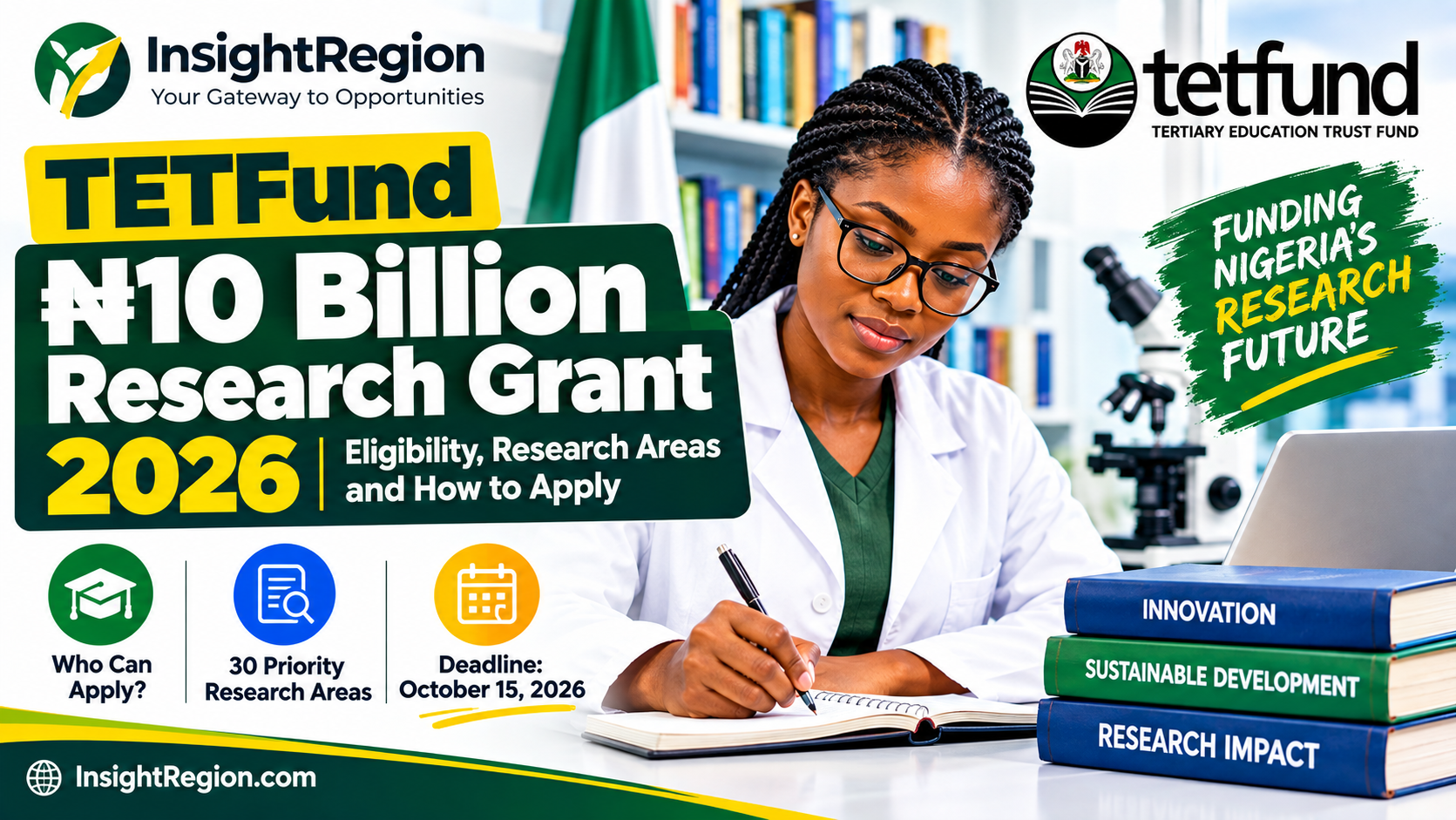
The Federal Government has approved ₦10 billion for the 2026 TETFund National Research Fund (NRF) Grant Cycle, creating a major research funding opportunity for eligible lecturers and academic researchers in Nigeria’s public tertiary institutions.
The 2026 TETFund National Research Fund is now open for the first stage of applications, with eligible Principal Investigators required to submit research Concept Notes through the official NRF application platform.
The application portal opened on August 31, 2026, while the deadline for submitting Concept Notes is October 15, 2026, Nigerian time. TETFund has specifically stated that there will be no extension of the deadline.
Importantly, applicants are not being asked to submit a full research proposal at the initial stage. Concept Notes will first be evaluated, and only research projects considered fundable will proceed to the Full Proposal stage.
This guide explains what the 2026 TETFund NRF opportunity is, who can apply, the 30 priority research areas, how the application process works, what researchers should consider when preparing a Concept Note and where to submit an application.
TETFund NRF 2026 at a Glance
| Opportunity | Details |
| Programme | TETFund National Research Fund |
| Grant cycle | 2026 |
| Total funding approved | ₦10 billion |
| Application stage | Concept Note |
| Portal opening | August 31, 2026 |
| Deadline | October 15, 2026 |
| Application method | Online |
| Target applicants | Eligible lecturers/researchers in Nigerian public tertiary institutions |
| Research areas | 30 priority thematic areas |
| Next stage | Full Proposal for successful Concept Notes |
| Final approval | TETFund Board of Trustees |
The ₦10 billion allocation follows the 2025 NRF cycle, under which TETFund says a little over ₦6.09 billion was awarded to support 174 research projects.
This means the 2026 funding envelope is significantly larger than the previous cycle, although applicants should understand that ₦10 billion is the total funding pool for the cycle, not an amount available to every researcher.
What Is the TETFund National Research Fund?
The National Research Fund (NRF) is a TETFund research intervention designed to support research projects that can contribute to solving important national and development challenges.



Unlike opportunities that are open to the general public, the NRF is structured around eligible researchers working within Nigeria’s public tertiary education system.
The 2026 call is organized around three broad research categories:
- Humanities and Social Sciences
- Science, Engineering, Technology and Innovation
- Cross-Cutting Research
Within these categories are 30 priority thematic areas covering issues ranging from education, governance and national integration to agriculture, health, energy, ICT, infrastructure, environmental sustainability and innovation.
The structure means that researchers should not simply submit an interesting research idea. A proposed project should have a clear connection with one of the identified thematic areas.
Who Can Apply for the TETFund NRF Grant 2026?
The opportunity is primarily for lecturers in Nigerian public tertiary institutions, with applications structured around a Principal Investigator (PI) and research team.
The 2026 call states that the Principal Investigator’s institution serves as the Coordinating Institution and guarantor of the proper application of funds for the research project. Multidisciplinary and interdisciplinary research involving researchers from different fields is encouraged.
Potential applicants should therefore first determine whether they and their institutions meet the requirements of the current call before beginning the application.
Who is a Principal Investigator?
The Principal Investigator is the researcher who leads the proposed project.
The PI is responsible for coordinating the research and is the person who submits the Concept Note through the NRF platform.
The official application platform requires prospective PIs to provide information including their:
- Academic rank
- Institution type
- Institution
- Highest qualification
- Qualification title
- Contact details
These fields are part of the official NRF registration process.
What about research teams?
Researchers do not necessarily have to work alone.
The 2026 call specifically encourages multidisciplinary and interdisciplinary research, meaning a strong project may bring together researchers with different academic backgrounds where that collaboration is relevant to the research problem.
For example, a research project examining the effect of digital technology on agricultural productivity could potentially involve expertise from agriculture, economics, computer science and data analysis.
The important point is that the team should be built around the research problem rather than simply adding people to the proposal.
What Research Areas Does the 2026 TETFund NRF Cover?
One of the most important things prospective applicants should do before preparing their Concept Note is identify the correct thematic area. The 2026 NRF call contains 30 prioritized research areas divided into three categories.
Category 1: Humanities and Social Sciences
1. Citizenship and National Integration
Research concerning citizenship, social cohesion, national identity and issues affecting Nigeria’s integration.
2. Conflict, Defence and Security
Research relating to conflict, security, defence and challenges affecting national stability.
3. Economic Development and Globalization
Research examining economic growth, development, globalization and their effects on Nigeria.
4. Education and Human Capital
Research concerning education, skills, human capital development and the factors affecting learning and workforce development.
5. Gender, Equity and Social Inclusion
Research addressing gender, inequality, inclusion and participation in society.
6. Governance, Politics, Law and Ethics
Research examining governance systems, political institutions, law, public administration and ethical issues.
7. History, Culture and Identities
Research concerning Nigeria’s history, culture, heritage and different forms of identity.
8. Humanities, Social Sciences, Technology and Business Interface
Research examining the relationship between society, technology, business and the humanities.
9. Languages, Literatures and Media
Research relating to languages, literature, communication, journalism and media.
10. Population and Migration
Research concerning population trends, migration, mobility and related socioeconomic issues.
11. Social Development and Welfare
Research examining social development, poverty, welfare and quality-of-life issues.
12. Tourism, Sports and Recreation
Research concerning tourism, sporting activities, recreation and their social and economic significance.
Category 2: Science, Engineering, Technology and Innovation
13. Agriculture and Food Security
Research aimed at improving agriculture, food production, food systems and food security.
14. Geosciences
Research involving geological and earth-related sciences.
15. Health and Social Welfare
Research addressing health challenges and their relationship with social welfare.
16. Industry and Innovation
Research involving industrial development, innovation and technology-driven economic activity.
17. Information Technology, Computing and Telecommunications
Research involving ICT, computing, telecommunications and related digital technologies.
18. Power and Energy
Research addressing energy production, access, efficiency, reliability and related challenges.
19. Science and Engineering
Research covering scientific and engineering problems with potential national or practical applications.
20. Space Science and Technology
Research relating to space science, space technology and associated applications.
21. Sustainable Use of Natural Resources and Terrestrial Ecosystems
Research concerning natural resources, ecosystems and sustainable environmental management.
22. Transport and Infrastructure
Research addressing transportation systems and infrastructure challenges.
23. Water and Sanitation
Research concerning water supply, sanitation and related public health and infrastructure challenges.
Category 3: Cross-Cutting Research
The final seven thematic areas are designed to address issues that can cut across several academic disciplines.
24. Blue Economy
Research concerning the sustainable economic use of marine and aquatic resources.
25. Clean and Affordable Energy
Research focused on cleaner, more accessible and affordable energy solutions.
26. Entrepreneurship and Wealth Creation
Research examining entrepreneurship, enterprise development, employment and wealth creation.
27. Environment, Housing, Urban and Regional Development
Research addressing environmental challenges, housing, cities and regional development.
28. Innovation and Technology in National Defence Capabilities
Research exploring technology and innovation that can contribute to national defence capabilities.
29. Resource Governance
Research concerning the management, utilization and governance of resources.
30. National System of Innovation
Research examining how Nigeria’s research, technology, industry and innovation systems can work together more effectively.
The 30 thematic areas are specified in the 2026 TETFund NRF call.
How to Apply for the TETFund NRF Grant 2026
The application process is conducted online through the TETFund National Research Fund platform. However, applicants should understand that the process involves more than simply creating an account and uploading a document.
Step 1: Confirm that you are eligible
Before developing the Concept Note, confirm that you meet the requirements of the current 2026 call. Pay particular attention to:
- Your institution
- Your academic position
- Your role as Principal Investigator
- Your research team
- The thematic area of the proposed project
Do not rely solely on requirements from older NRF cycles. Applicants should use the current 2026 call and current portal instructions when making their final eligibility assessment.
Step 2: Identify the right research problem
A strong application should begin with a clearly defined research problem.
Ask: What problem am I trying to solve?
Then ask: Why does solving this problem matter?
And finally: What evidence will this research produce that could help address the problem?
This is much stronger than beginning with a broad subject such as “the impact of technology in Nigeria.”
A more focused research question might examine how a particular digital intervention affects a specific population, institution, industry or development outcome.
Step 3: Match the project to a priority area
Once the research problem has been defined, determine which of the 30 NRF thematic areas best fits it. This matters because the 2026 call is explicitly structured around prioritized thematic areas.
Your research title, problem statement, objectives and expected outcomes should therefore tell a consistent story.
Step 4: Study the Research Brief and application guidelines
TETFund specifically advises applicants to familiarize themselves with the Research Brief and Guidelines for the application before submitting their work. This step should not be treated as optional reading.
The official NRF platform provides access to research guidance materials alongside the application system. Researchers should always use the current documents provided through the official TETFund/NRF system rather than relying on copies circulating on social media or third-party opportunity websites.
Step 5: Create your NRF account
The official NRF registration platform asks prospective Principal Investigators to create an account.
Applicants are required to provide information such as their name, contact details, date of birth, academic rank, institution type, institution, highest qualification and email address.
Official NRF application portal
Apply through the TETFund National Research Fund portal
The official platform provides options for registering as a new Principal Investigator and subsequently submitting Concept Notes and Full Proposals.
What Is a TETFund NRF Concept Note?
The Concept Note is the starting point of the 2026 application process. Applicants should not assume that submitting a Concept Note is equivalent to receiving funding.
According to the 2026 call, submitted Concept Notes will first be evaluated by the National Research Fund Screening and Monitoring Committee (NRFS&MC). Researchers whose Concept Notes are considered fundable will then be invited to proceed to the Full Proposal stage.
This makes the Concept Note an important first opportunity to demonstrate that the proposed research deserves further consideration.
How to Write a Research Concept Note – What Should a Strong Research Concept Note Show?
While researchers should follow the current 2026 application template and instructions, the underlying principle is straightforward:
The reviewer should quickly understand the problem, why it matters, what you intend to investigate, how you intend to do it and what the research could contribute.
A strong proposal should therefore have a clear connection between its: Problem → Objectives → Methodology → Outputs → Impact
1. A clearly defined problem
Do not try to solve every aspect of a national problem in one project. Define a manageable research problem.
2. A strong justification
Explain why the research is necessary. Why does the problem deserve investigation now? Who is affected? What gap exists in current knowledge?
3. Clear objectives
Research objectives should be specific enough to guide the actual research.
Older TETFund NRF proposal guidance, for example, emphasizes objectives that are Specific, Measurable, Achievable, Realistic and Time-bound (SMART). Applicants should nevertheless follow the current 2026 template where requirements differ.
4. A credible methodology
Explain how the research question will be investigated. The methodology should be appropriate for the problem rather than selected simply because it is familiar to the researcher.
5. Measurable outcomes
Explain what the research is expected to produce. Possible outputs could include:
- Research findings
- Data
- Models
- Policy recommendations
- Technical solutions
- Academic publications
- Prototypes
- Evidence for institutional decision-making
- The appropriate outputs will depend on the nature of the research.
6. Potential impact
A strong research idea should make it possible to explain what could change if the research succeeds.
For example:
- Could the findings improve policy?
- Could they improve agricultural productivity?
- Could they contribute to better healthcare?
- Could they support education?
- Could they improve security?
- Could they produce a technological solution?
The answer should be specific to the project.
How to Make a TETFund Research Proposal More Competitive
There is no legitimate formula that guarantees NRF funding. However, researchers can make their proposals stronger by focusing on several fundamentals.
Start with a real problem
Avoid choosing a research topic simply because it sounds fashionable. Start with a genuine problem that requires evidence.
Make the Nigerian relevance clear
The NRF is a national research funding mechanism. Researchers should therefore be able to explain the relevance of their work to Nigeria’s development, institutions, communities, industries or public policy.
Keep the research question focused
A proposal attempting to investigate an enormous national problem may become difficult to execute effectively. A narrower, well-designed study can often produce more useful evidence.
Build the right research team
If a problem crosses several disciplines, consider an interdisciplinary team. But collaboration should have a clear purpose.
Make the methodology believable
A reviewer should be able to understand how the proposed research can realistically be completed.
Think about impact from the beginning
Don’t wait until the final section to mention impact. The research problem, methodology and expected outcomes should naturally lead to the claimed impact.
Use a realistic timeline
The research schedule should correspond with the actual activities involved.
TETFund’s published proposal guidance has historically required clear project duration, activities and timelines, so applicants should pay close attention to the current 2026 requirements.
What Happens After the Concept Note?
Submitting the Concept Note is only the beginning of the selection process. According to the 2026 call, the process broadly follows this path:
Concept Note submission
↓
Evaluation by the National Research Fund Screening and Monitoring Committee
↓
Successful applicants invited to prepare Full Proposals
↓
Full Proposal evaluation
↓
Proposal defence by the PI and at least one research-team member for projects screened and adjudged fundable
↓
Successful proposals presented to the TETFund Board of Trustees
↓
Approval and disbursement of funds
This means applicants should be prepared for a competitive process rather than assuming that submission automatically leads to an award.
TETFund NRF 2026 Application Deadline
October 15, 2026
This is one of the most important dates prospective applicants should remember.
The TETFund 2026 call states that the portal opened for Concept Note submissions on August 31, 2026, and that the deadline is October 15, 2026, Nigerian time.
TETFund has also stated clearly: There will be no extension. Applicants should therefore avoid leaving registration, Concept Note preparation or submission until the final day.
Where Can You Apply?
The official application platform is the TETFund National Research Fund Grant Application Platform.
The platform currently provides options for new Principal Investigators to create accounts, sign in and access the relevant research materials.
Applicants should be particularly careful about unofficial websites asking for money or personal information in exchange for access to the grant.
The safest approach is to begin from TETFund’s official website or the official NRF application platform.
Important Things to Check Before You Submit
Before clicking the final submission button, prospective applicants should work through a simple checklist:
- I have confirmed that I am eligible under the 2026 call.
- My institution meets the applicable requirements.
- My research fits one of the 30 priority thematic areas.
- I have clearly defined the research problem.
- My objectives are clear.
- My methodology is appropriate.
- My research team has the expertise required.
- My expected outputs are realistic.
- I have explained the potential impact.
- I have followed the current TETFund NRF guidelines.
- I have checked the Concept Note carefully.
- I have allowed enough time for technical or submission problems.
- I will submit before October 15, 2026.
Common Mistakes Researchers Should Avoid
The following are practical warnings rather than an official TETFund list of disqualifying mistakes.
Applying with an unfocused research idea
A broad topic is not necessarily a strong research proposal.
Ignoring the thematic areas
A good research idea still needs to fit the structure of the current NRF call.
Using outdated guidelines
TETFund’s NRF has gone through different cycles and its requirements and thematic structures can change. Always prioritize the current 2026 call and current portal instructions.
Confusing registration with funding
Creating an NRF account does not mean that funding has been awarded. Neither does submitting a Concept Note.
Waiting until the deadline
Technical difficulties, missing information or last-minute revisions can create unnecessary problems.
Copying another research proposal
A proposal should be based on the researcher’s own problem, methodology and evidence. Researchers should also ensure that all academic work complies with applicable research integrity and intellectual-property requirements.
Frequently Asked Questions About the TETFund NRF Grant 2026
What is the TETFund NRF grant 2026?
It is the 2026 cycle of TETFund’s National Research Fund, with the Federal Government approving ₦10 billion to support eligible research projects.
How much money has been approved for the 2026 TETFund NRF?
The Federal Government has approved ₦10 billion for the 2026 NRF Grant Cycle.
Who can apply for the TETFund research grant?
The opportunity is designed for eligible lecturers and Principal Investigators in Nigeria’s public tertiary institutions, subject to the requirements of the current call.
What are the TETFund NRF research areas for 2026?
There are 30 prioritized thematic areas covering Humanities and Social Sciences, Science/Engineering/Technology/Innovation and Cross-Cutting research.
When is the TETFund NRF 2026 deadline?
The deadline for Concept Note submissions is October 15, 2026, Nigerian time. TETFund states that there will be no extension.
When did the application open?
The portal opened for Concept Note submissions on August 31, 2026.
Do applicants submit a full proposal immediately?
No. The 2026 process begins with a Concept Note. Applicants whose Concept Notes are evaluated and considered fundable will be invited to prepare and submit Full Proposals.
Can researchers from different disciplines work together?
Yes. The 2026 call specifically encourages multidisciplinary and interdisciplinary research.
Where can I apply for the TETFund NRF grant?
Applications are submitted through the official TETFund National Research Fund Grant Application Platform at nrf.tetfund.gov.ng.
Final Takeaway
The 2026 TETFund National Research Fund presents a significant opportunity for Nigerian researchers working on problems that matter to the country’s development.
With ₦10 billion approved for the grant cycle, researchers across the humanities, social sciences, science, engineering, technology, innovation and cross-cutting fields have an opportunity to put forward projects aligned with the programme’s 30 priority thematic areas.
But the size of the funding pool should not create the impression that the money is automatically available to everyone who applies.
The process is competitive. The first hurdle is a strong Concept Note that clearly demonstrates the problem being investigated, why the research matters, how it will be conducted and what useful outcomes it could produce.
Researchers who believe they are eligible should therefore start early, study the current TETFund NRF Research Brief and application guidance, carefully match their project to an appropriate thematic area and complete their submission through the official portal.
Key deadline to remember:
October 15, 2026 — Concept Note submission closes. No extension is expected.
For the safest and most up-to-date application information, prospective applicants should use the official TETFund NRF platform rather than relying on third-party summaries.
Official application portal: TETFund National Research Fund Grant Application Platform