Dangote Refinery to Double Workforce, Target 1.4m BPD by 2029: Expansion, Opportunities and Jobs for Nigerians
Dangote Refinery to Double Workforce, Target 1.4m BPD by 2029: Jobs, Expansion and What Nigerians Should Know

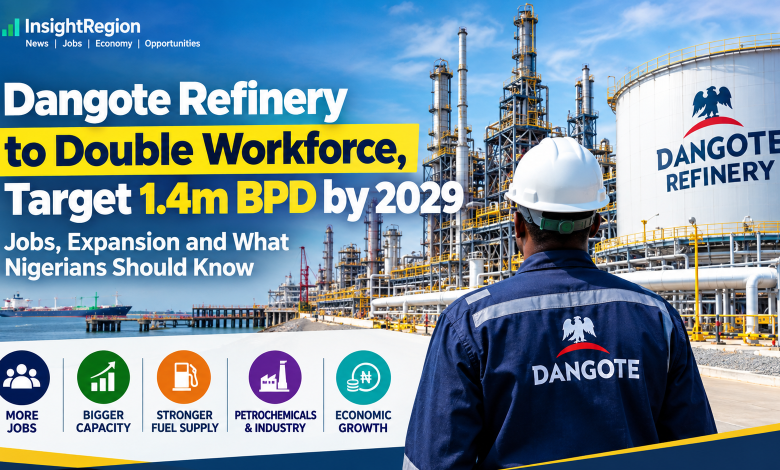
Dangote Refinery is preparing for another major expansion that could significantly reshape Nigeria’s refining industry, with the company saying it plans to double its workforce as it targets a refining capacity of 1.4 million barrels per day by 2029.
The announcement places jobs, industrial development, fuel supply and the future of Nigeria’s oil and gas sector at the centre of renewed attention around Africa’s largest single-train refinery.
The latest development was disclosed by Devakumar Edwin, Group Vice President, Oil and Gas and Fertiliser at Dangote Industries Limited, during a media tour of the refinery in Lagos on September 18, 2026.
According to the News Agency of Nigeria (NAN), Edwin said the refinery currently operates at about 700,000 barrels per day and is targeting 1.4 million barrels per day as part of its planned expansion. He said basic engineering had already been completed, almost all detailed engineering work was concluded, most equipment had been ordered and major contracts had been signed, with advance payments made to contractors.
For Nigerians, however, the most immediately interesting part of the announcement may not be the headline production figure. It is the potential impact on jobs and skills.
Dangote Refinery plans to double its workforce
Edwin said the workforce within the refinery would “practically become double” as the facility expands, although some sections would not require a proportional increase in personnel.
The water treatment section, for example, already has substantial capacity, while the company does not expect a major increase in its transport workforce unless domestic consumption of petrol and diesel rises significantly.
This means the planned workforce expansion should not be interpreted as a promise that every part of the refinery will employ twice as many people.
Instead, it reflects the additional personnel required to support a substantially larger and more complex industrial operation. That distinction is important for anyone searching online for Dangote Refinery jobs or recruitment.



The announcement is about planned workforce expansion. It is not, by itself, an announcement of a new recruitment exercise or an indication that applications are currently open.
The expansion could create far more work beyond permanent refinery jobs
The potential employment impact could extend beyond the refinery’s permanent workforce.
In April 2026, Aliko Dangote said the expansion could require about 95,000 skilled workers at the peak of construction. That figure refers to the expected construction workforce and should not be confused with the number of permanent employees who will operate the expanded refinery after completion.
Large industrial projects create layers of employment involving engineers, technicians, fabricators, electricians, welders, instrumentation specialists, construction workers, safety professionals, logistics providers, equipment suppliers and other contractors.
The refinery itself has also described its wider operation as an integrated industrial ecosystem involving refining, petrochemicals, power, storage, marine infrastructure and logistics.
Consequently, the economic impact of an expansion to 1.4 million barrels per day could extend well beyond people whose job titles contain the words “refinery” or “oil and gas.”
What skills could become more important?
For young Nigerians and professionals watching the development from a career perspective, the expansion offers an indication of the kinds of technical capabilities that could become increasingly valuable around large-scale industrial projects.
Potential areas include:
- Mechanical engineering
- Chemical and process engineering
- Electrical engineering
- Instrumentation and control
- Industrial automation
- Welding and fabrication
- Plant maintenance
- Process operations
- Laboratory and quality control
- Health, safety and environment
- Industrial ICT and digital systems
- Logistics and supply-chain management
- Marine and port operations
- Construction management
- Equipment inspection and testing
The increasing role of automation is particularly significant.
NAN reported during the refinery tour that more than 70 per cent of the facility is automated. That suggests that the future employment picture will not simply be about creating more conventional manual jobs.
It could increasingly involve people capable of operating, maintaining, monitoring and improving highly automated industrial systems.
For Nigerian graduates, technicians and artisans, this makes technical training and internationally relevant certifications potentially important preparation for opportunities created by large industrial projects.
But it is worth repeating: these are potential areas of demand, not a list of vacancies announced by Dangote Refinery.
From 700,000 to 1.4 million barrels per day
The scale of the planned expansion is substantial. Dangote Refinery’s current crude distillation capacity is approximately 700,000 barrels per day, while the company’s stated expansion target is 1.4 million barrels per day.
The refinery’s own website describes 1.4 million barrels per day as its planned expanded capacity and currently lists 700,000 bpd as its refining capacity.
If achieved, the expansion would effectively double the refinery’s processing capacity.
Edwin said the expansion could cost less than the original project because much of the supporting infrastructure is already available.
The first phase required major infrastructure including the port facility, quarry, welding-gas plant and developed land. Much of that infrastructure can support the expansion, while the company expects some engineering and design work to be replicated rather than undertaken entirely from scratch.
The company is also considering additional petrochemical facilities as part of the broader expansion.
Why 1.4 million barrels per day matters to Nigeria
The significance of the project goes beyond the size of the refinery itself.
Nigeria is one of Africa’s major crude oil producers, yet for years the country relied heavily on imported refined petroleum products because domestic refining capacity was inadequate or unreliable.
A refinery capable of processing substantially more crude domestically could therefore have implications for the country’s fuel supply chain, petroleum imports, foreign exchange requirements and regional fuel trade.
Dangote says its refinery is designed to process a wide range of crude grades, including African crude and US West Texas Intermediate, rather than depending exclusively on one source of crude.
The company also says the refinery is configured to maximise petrol production in response to Nigeria’s consumption pattern.
At the same time, the refinery has increasingly become an exporter of refined products. Reuters reported in September that Dangote Refinery had become a significant supplier of products including jet fuel and diesel to international markets.
That means the expansion is potentially both a domestic energy story and an international trade story.
It is not only about petrol
One of the less discussed aspects of the expansion is the wider industrial ecosystem surrounding the refinery.
The Dangote facility is not simply a petrol plant. Its operations include refining, petrochemicals, storage, marine infrastructure and logistics, while its website lists polypropylene production among its activities.
NAN also reported that the broader development includes plans involving petrochemical products such as linear alkyl benzene, base oil and polypropylene.
This matters because petrochemicals can supply raw materials to other industries.
A stronger domestic petrochemical base could potentially support businesses involved in plastics, packaging, manufacturing and other downstream activities, creating opportunities further along the industrial value chain.
In other words, the economic story is potentially bigger than the number of people employed directly inside the refinery.
The Dangote IPO connection
The timing of the expansion is particularly significant because Dangote Refinery is currently conducting a major public share offering.
The Securities and Exchange Commission (SEC) confirmed that the Dangote Petroleum Refinery and Petrochemicals IPO opened on September 14, 2026, and warned prospective investors to use only officially designated and approved channels.
Reuters reported that the offering involves 4.1 billion shares at ₦525 per share, with the company seeking approximately ₦2.15 trillion in equity capital. The proceeds are intended to support the planned expansion to 1.4 million barrels per day.
That makes the latest workforce announcement particularly notable.
Nigerians are hearing about the company’s planned expansion at the same time that the company is seeking to broaden public ownership through the IPO.
The two developments should not be confused, however.
The workforce announcement concerns the company’s operational and expansion plans, while the IPO concerns investment in the company. Buying shares does not guarantee employment, and the announcement of additional jobs does not constitute an investment recommendation.
The SEC has specifically advised potential investors to read the approved prospectus, understand the risks and use only authorised channels.
What about the 2029 deadline?
The latest announcement from Dangote Industries puts the expansion target at 2029. Edwin said the company was targeting three years and could potentially complete the work faster.
That means 2029 should currently be understood as the latest target communicated by the company through Edwin’s September 18 statement, rather than a guaranteed completion date. The actual schedule will depend on construction, equipment installation, commissioning, crude supply and other operational factors.
One important issue is crude supply.
Recent reporting based on the IPO prospectus noted that the refinery will need continuous and reliable crude supplies to operate an expanded facility efficiently. In 2025, approximately 60 per cent of its crude feedstock reportedly came from Nigeria through term contracts and other domestic arrangements, with the remainder coming from international sources.
Therefore, doubling refining capacity is not simply a matter of installing more equipment.
The expanded plant will also require adequate crude, infrastructure, logistics, skilled personnel and reliable operations.
What Nigerians should watch next
For job seekers and professionals, the most useful thing now is to distinguish future opportunity signals from actual Dangote recruitment announcements.
Among the developments worth watching are:
- Official recruitment: Any new vacancies should be verified through Dangote’s official channels.
- Expansion contracts: Major construction and engineering contracts can create contractor and specialist opportunities before the expanded refinery becomes operational.
- Technical training: Apprenticeships, certifications and specialist training could become increasingly relevant as the facility becomes more automated.
- Local suppliers: Expansion can generate demand for equipment, maintenance, transportation, engineering and other services.
- Refinery progress: Equipment delivery, construction, installation and commissioning milestones will provide a clearer picture of how quickly the 1.4m-bpd target is progressing.
- Fuel production and exports: Increasing capacity could affect the volume of petroleum products available to Nigeria and regional markets.
What the Dangote expansion could mean for ordinary Nigerians
The biggest question is ultimately whether the expansion can translate into tangible economic benefits beyond the refinery gates.
There are several potential channels.
More direct and indirect employment could benefit workers and households. Greater demand for technical expertise could encourage investment in vocational and engineering skills. Increased refining capacity could strengthen Nigeria’s domestic petroleum-processing capability. Petrochemical expansion could support downstream manufacturing. And greater exports of refined products could generate foreign-exchange earnings.
But these outcomes should be viewed as potential benefits rather than guaranteed results. The expansion still has to be completed, supplied with crude, operated efficiently and integrated into Nigeria’s wider economy.
For job seekers, perhaps the clearest lesson is that the opportunity is not necessarily to wait for a “Dangote Refinery recruitment” headline. It is to watch the project while building skills that large-scale industrial operations actually require.
For Nigeria, the larger test will be whether a world-scale refinery can develop into a wider ecosystem of jobs, skills, manufacturing, exports and industrial activity.
With Dangote Refinery now targeting 1.4 million barrels per day by 2029 and planning to expand its workforce, the next phase could be just as important as the construction of the original facility.
And for Nigerians watching from outside the refinery gates, the most important question may no longer be simply how much the refinery can produce — but how much economic opportunity its expansion can create across the country.
Source references: News Agency of Nigeria (NAN), Dangote Refinery, Securities and Exchange Commission (SEC), Reuters, Premium Times and BusinessDay.