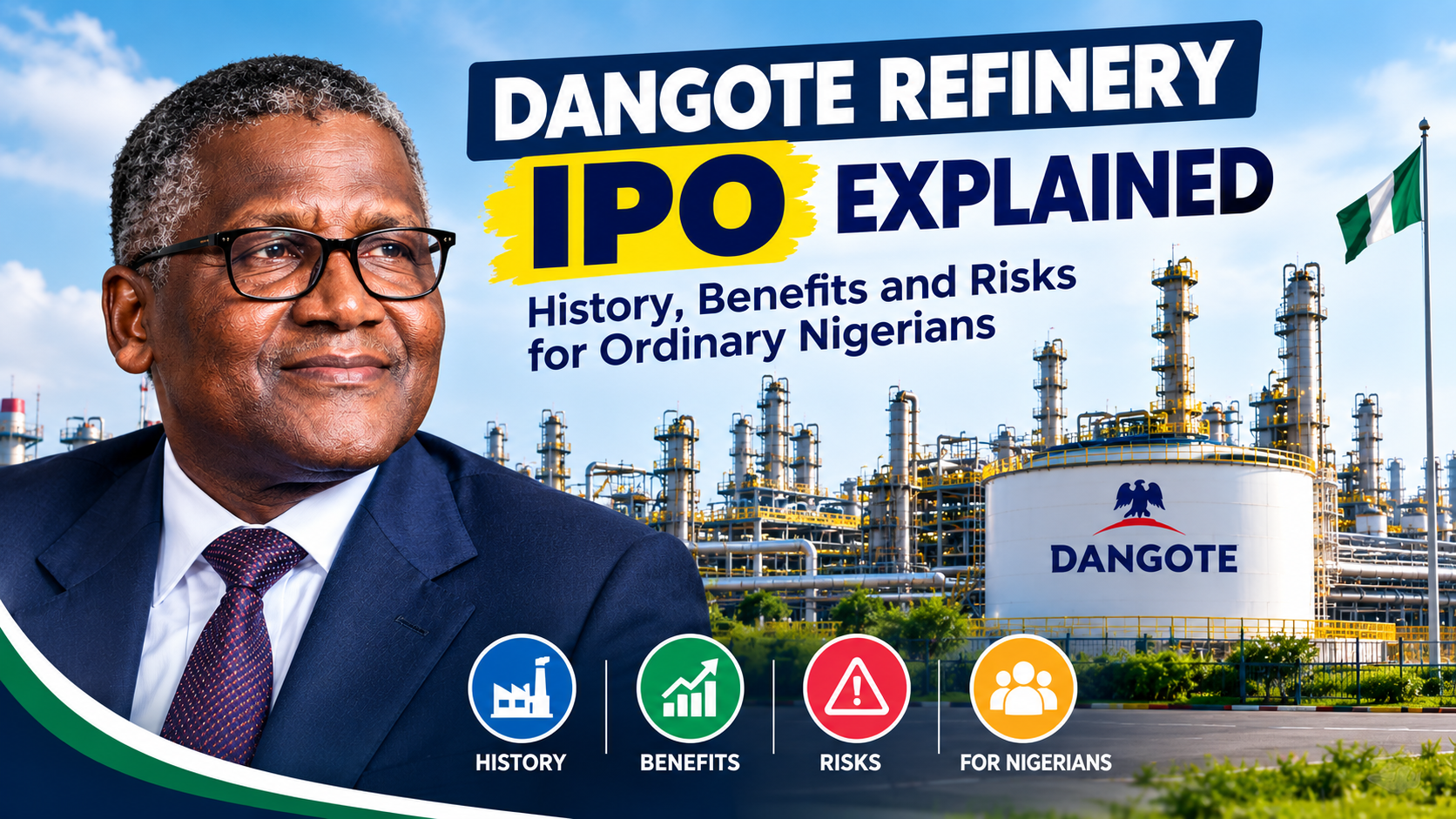
The proposed Dangote Refinery IPO is giving ordinary Nigerians something they have rarely been offered: the opportunity to potentially become shareholders in one of the country’s most ambitious industrial projects.
With shares being offered at ₦525 each and a minimum subscription of 10 shares, or ₦5,250, the public offer is designed to make participation accessible to a much wider group of investors. The official IPO website describes it as the “IPO for the People”, while stressing that investing in shares carries risk and that applicants should read the prospectus before subscribing.
But before deciding whether to invest, there is a more important question to answer: What exactly are Nigerians being invited to own?
The answer is much bigger than a refinery.
The Dangote Refinery represents years of investment, infrastructure development, industrial ambition and attempts to change how Nigeria produces and supplies petroleum products.
The IPO therefore creates an opportunity to look beyond the excitement surrounding the share offer and understand the business behind it.
This is the story of how the refinery developed, why it matters to Nigeria, what shareholders could potentially gain and the risks investors need to understand before putting their money into the company.
From an ambitious idea to a landmark Nigerian industrial project
The Dangote Refinery was conceived against a familiar Nigerian problem: a country that produces crude oil but has historically depended heavily on imported refined petroleum products.
For decades, Nigeria’s limited domestic refining capacity contributed to fuel-import dependence, foreign-exchange pressures and recurring concerns about the reliability of petroleum-product supply. The Dangote project was intended to change that equation.



Construction of the refinery became one of the largest private industrial projects ever undertaken in Africa. The facility eventually cost about $20 billion to build and began production in January 2024. Reuters has described it as Africa’s largest refinery, with its original capacity placed at about 650,000 barrels per day; the facility has subsequently tested production at around 700,000 barrels per day.
That scale matters.
A refinery processing hundreds of thousands of barrels of crude every day is not simply another private company. Its operations can influence fuel supply, imports, exports, foreign exchange, logistics, employment and the wider Nigerian energy market.
Why building the refinery was so important
Nigeria has enormous crude-oil resources, but crude production alone does not provide consumers with petrol, diesel, aviation fuel and other finished petroleum products. Crude has to be refined.
For years, Nigeria exported crude and imported significant quantities of refined products. The Dangote Refinery was built to help address that structural imbalance.
Its operations can potentially allow more petroleum products consumed in Nigeria to be produced domestically while also creating the capacity to export products to other markets.
The refinery’s coastal location also gives it access to international shipping routes, which is important for both crude sourcing and petroleum-product exports.
But the road to production was not straightforward. The project encountered major construction, financing, infrastructure and crude-supply challenges.
Even after production began, securing sufficient crude has remained an important issue. Reuters reported in 2024 that the refinery had to import crude because domestic supplies were not always sufficient.
That history is important for investors because it illustrates a fundamental principle:
A huge industrial asset can be valuable while still facing significant business risks.
The refinery is now entering another phase
The IPO represents another major milestone in the refinery’s development. Instead of remaining primarily a privately owned industrial asset, the company is seeking to broaden ownership through a public share offering.
The current offer terms announced on the official IPO website are:
| IPO detail | Current information |
| Offer price | ₦525 per share |
| Minimum subscription | 10 shares |
| Minimum investment | ₦5,250 |
| Shares being offered | 4.1 billion |
| Expected proceeds | About ₦2.15 trillion |
| Purpose | Expansion and growth |
The official website says eligible investors can apply for shares and become shareholders if shares are allotted to them. It also makes clear that submitting an application does not guarantee allotment.
The proposed fundraising is expected to support the refinery’s next stage of expansion.
Why is Dangote selling shares?
There are two important answers.
1. To raise capital
The IPO could raise approximately ₦2.15 trillion, according to current reporting.
The refinery is preparing for an enormous expansion that would increase its processing capacity from around 700,000 barrels per day toward 1.4 million barrels per day.
Reuters reports that the planned expansion is estimated at approximately $14.3 billion and is targeted for completion around 2029.
Such an expansion requires enormous amounts of capital. A public offering provides one way of raising that money.
2. To broaden ownership
This is the more unusual part of the story. Aliko Dangote has repeatedly described the transaction as an “IPO for the people.”
He has specifically spoken about drivers, cooks, traders, managers and other ordinary people having an opportunity to own shares.
That means the IPO is being presented not simply as a fundraising exercise but also as a way of widening participation in one of Africa’s largest industrial businesses. For ordinary Nigerians, this is potentially the most important feature of the offer.
What are you actually buying when you buy Dangote Refinery shares?
This is where first-time investors need to slow down. Buying Dangote Refinery shares does not mean buying petrol.
It does not mean buying a barrel of crude. It does not mean receiving a fixed amount of money every month.
You are buying an ownership interest in the company, if your application is allotted.
As a shareholder, your potential financial benefits can come primarily through two routes:
- Dividends — if the company declares and pays dividends.
- Capital appreciation — if the value of the shares increases and you later sell at a higher price.
But neither outcome is guaranteed. The official IPO website explicitly warns that the value of an investment can rise or fall and that investors may not recover the amount they invest.
That distinction should be understood before anyone applies.
The potential benefit: owning part of a major African industrial asset
One attraction of the IPO is the opportunity to gain exposure to a business operating in an industry that is strategically important to Nigeria and Africa.
The refinery has already achieved an enormous physical scale. Its expansion could make it even more significant.
If the company successfully increases production, secures adequate crude supplies, maintains strong refining margins and expands its customer base, shareholders could potentially benefit from the resulting growth.
This is the basic investment proposition: If the underlying business becomes more valuable and profitable over time, shareholders may benefit.
But investors should remember that the opposite is also possible. If profitability falls, costs increase or expansion encounters serious difficulties, shareholders can be affected negatively.
Potential benefit #1: Dividend income
One of the traditional reasons people buy shares is the possibility of receiving dividends. A profitable company may decide to distribute part of its earnings to shareholders.
Dangote has also spoken publicly about the possibility of future dollar-denominated dividends, including the prospect of shareholders receiving foreign-currency income. That has attracted considerable attention among Nigerian investors.
However, investors should not treat this as a guaranteed payment.
Dividends are not automatic.
They depend on factors including profitability, cash requirements, board recommendations, shareholder approval where applicable, company policy and regulatory requirements.
Therefore, someone considering the IPO should distinguish between: “The company may pay dividends.” and: “I am guaranteed a dividend.”
The first may be possible. The second should never be assumed.
Potential benefit #2: Capital appreciation
The second potential source of return is an increase in the market value of the shares. Suppose an investor receives 100 shares at the IPO price of ₦525. The initial share value would be: 100 × ₦525 = ₦52,500
If the shares later trade above ₦525, the investor’s holding would have increased in market value. If they fall below ₦525, the holding would be worth less. This is why the IPO price should never be interpreted as a guaranteed future value.
A company’s share price is influenced by its financial performance, investor expectations, market conditions, interest rates, economic conditions and many other factors.
Potential benefit #3: Exposure to Nigeria’s energy transformation
For investors who believe Nigeria’s energy and industrial sectors will expand over the long term, the refinery offers exposure to that transformation. The company’s ambitions go beyond simply supplying Nigeria.
Dangote has discussed expanding its refining footprint across Africa, while the group is pursuing a separate major refinery project in Kenya. Reuters reported this week that the proposed Kenyan refinery is expected to have a capacity of about 700,000 barrels per day.
If the Dangote Group successfully develops a broader African refining network, the Nigerian refinery could become part of a much larger energy business. But that is a growth strategy, not a guaranteed outcome.
Potential benefit #4: A potentially stronger position in regional fuel markets
The Dangote Refinery has the capacity to supply petroleum products beyond Nigeria. Its scale and coastal location give it the potential to serve markets across West Africa and other regions. That creates another possible source of long-term growth.
Instead of depending solely on Nigerian demand, a large refinery can potentially sell products into international markets when commercial conditions make that attractive.
For investors, geographic diversification can matter because it means the company’s growth is not necessarily tied to one country’s consumption alone.
Potential benefit #5: Participation in industrial development
There is also a broader economic argument. When Nigerians own shares in major companies, they participate financially in the country’s corporate economy.
Instead of wealth creation being concentrated entirely among founders and private investors, public markets can allow a larger population to participate. That is the broader meaning behind Dangote’s “IPO for the people” message.
A successful public offering could help introduce more Nigerians to formal equity investing and potentially encourage greater participation in the Nigerian capital market.
But the benefit only becomes meaningful if people invest responsibly and understand what they are buying.
The refinery’s biggest opportunity may also be its biggest challenge
The planned expansion from around 700,000 barrels per day toward 1.4 million barrels per day is enormous. More capacity could mean:
- greater production;
- higher sales;
- more export opportunities;
- stronger economies of scale;
- broader regional market access; and
- potentially higher earnings.
But bigger capacity also creates bigger requirements. The refinery needs reliable crude supplies. It needs efficient logistics. It needs strong operational performance. It needs customers. And it needs to maintain competitive refining margins.
Reuters reported that crude sourcing remains an important issue for investors, with the refinery sourcing a significant portion of its crude internationally because domestic supplies can be insufficient or expensive. That is an important risk to watch.
A refinery can have enormous physical capacity and still struggle to maximise profitability if the economics of obtaining crude are unfavourable.
What could make the investment attractive?
Investors considering the IPO should think less about the personality of Aliko Dangote and more about the economics of the business. Important factors include:
- Refinery utilisation – How much of its available capacity can the refinery consistently operate?
- Crude supply – Can it obtain enough crude at competitive prices?
- Refining margins – Can it convert crude into products profitably?
- Product demand – Will Nigeria and international markets continue absorbing its output?
- Expansion execution – Can the company complete its planned expansion within a reasonable cost and timeframe?
- Cash flow – Is the business generating sufficient cash to support operations, expansion and potential dividends?
- Debt and financing – How will future expansion be financed, and what effect could financing costs have on shareholders?
These questions are more useful than simply asking whether Dangote Refinery is “a good company.”
What could go wrong?
Every investment has risks, and the Dangote Refinery is no exception.
- Crude supply risk – Insufficient or expensive crude can reduce refinery utilisation and profitability.
- Oil-market risk – Changes in crude prices and refined-product prices can affect refining margins.
- Currency risk – Exchange-rate movements can influence costs, financing and returns.
- Regulatory risk – Changes to petroleum-sector regulations, taxes, tariffs and government policy can affect the business.
- Competition – Other refineries and international suppliers can compete for the same customers.
- Expansion risk – The planned doubling of capacity is a massive engineering and financial undertaking.
- Valuation risk – Even an excellent company can be a poor investment if its shares are purchased at an excessively high valuation.
Reuters has reported that analysts are examining the refinery’s valuation against international refining companies, highlighting the importance of looking beyond the excitement surrounding the IPO.
Is ₦525 per share cheap?
This is one of the questions investors will naturally ask. But the share price alone cannot tell you whether a stock is cheap or expensive.
A ₦525 share can be expensive. A ₦5,000 share can be cheap.
What matters is the relationship between the share price and the company’s underlying financial performance and prospects. Investors should examine measures such as:
- earnings;
- revenue;
- cash flow;
- debt;
- profitability;
- market capitalisation;
- price-to-earnings ratio;
- enterprise value;
- expected growth; and
- comparable companies.
The IPO valuation reported by Reuters is around $47 billion, making valuation one of the central issues investors will need to consider.
That is precisely why the prospectus matters. The prospectus should provide the financial and risk information investors need to assess the offer properly.
Who might find the IPO attractive?
The opportunity could be relevant to investors who:
- have a long-term investment horizon;
- understand that shares can lose value;
- want exposure to Nigeria’s energy sector;
- are building a diversified portfolio;
- are interested in industrial and infrastructure businesses; and
- can afford to invest without compromising essential financial needs.
The low minimum subscription makes participation accessible, but accessibility does not mean everyone should invest.
Who should be especially cautious?
The IPO may not be appropriate for someone who:
- needs the money for immediate expenses;
- is borrowing at high interest to invest;
- expects guaranteed profits;
- is investing simply because friends or social-media personalities recommend it;
- believes Dangote’s reputation eliminates investment risk; or
- does not understand how shares work.
The official IPO website itself advises investors to read the prospectus and consult issuing houses, stockbrokers or financial advisers where necessary.
What makes this IPO historically significant?
The significance of the Dangote Refinery IPO goes beyond the number of shares being offered. It represents the intersection of industrialisation and public investment.
For decades, Nigerians have discussed the need for large domestic industries capable of reducing dependence on imports and creating economic opportunities. The refinery represents one of the largest attempts by private capital to build that kind of industrial infrastructure.
Now, through the IPO, ordinary investors are being given an opportunity to potentially participate in the financial ownership of that asset.
If successful, it could help demonstrate how Nigeria’s capital market can connect ordinary household savings with major productive businesses.
That does not mean every investor will make money. It means the ownership opportunity is becoming broader.
The bigger question for ordinary Nigerians
The most important question is not: “Can I afford the ₦5,250 minimum?” For many people, the answer may be yes.
The better questions are:
- Do I understand what I am buying?
- Can I afford to lose some or all of the money invested?
- Have I read the offer documents?
- Do I understand how the company makes money?
- Have I considered the risks?
- Am I investing for the long term or simply chasing hype?
Those questions matter because the Dangote Refinery is a business, not a savings account.
Its future value will ultimately depend on its ability to operate efficiently, obtain crude, sell products profitably, expand successfully and generate sustainable cash flow.
The Dangote Refinery IPO is an opportunity — not a guarantee
The proposed IPO could become a landmark moment for Nigeria’s capital market. It gives ordinary Nigerians the possibility of owning part of a major industrial company with ambitions extending beyond Nigeria.
The potential benefits are significant: dividend income, capital appreciation, exposure to energy and industrial growth, and participation in the ownership of a major African business.
But the risks are equally real. Crude supply, operating costs, exchange rates, regulation, market conditions, expansion execution and valuation can all influence the eventual outcome for shareholders.
That is why the most responsible way to approach the Dangote Refinery IPO is neither blind optimism nor automatic scepticism. It is informed participation.
The official IPO website currently confirms the offer price of ₦525 per share and minimum subscription of 10 shares or ₦5,250, while advising investors to read the prospectus before subscribing.
For Nigerians who decide to participate, the goal should not simply be to say: “I own Dangote shares.”
The goal should be to understand why you own them, what you expect from the investment, what could go wrong and how long you are prepared to stay invested.
That is the difference between investing because of excitement and investing with a plan.
The bottom line
The Dangote Refinery has already changed the conversation about refining and industrial capacity in Nigeria.
The IPO could now change another conversation: who gets to participate in the financial ownership of major Nigerian businesses. With the minimum subscription set at ₦5,250, ordinary Nigerians have been given a relatively accessible entry point.
But the real opportunity is not the low entry price. It is the possibility of becoming a long-term shareholder in a business whose success could have implications for Nigeria’s energy market and the wider African economy.
Whether that becomes a rewarding investment will ultimately depend on the company’s performance — not the excitement surrounding the IPO.
Before investing, read the prospectus, understand the risks and make the decision based on your own financial circumstances rather than pressure from social media or promises of guaranteed returns.
What to read next
Want to apply for the Dangote Refinery IPO? Our next guide explains how the subscription process works, what you need before applying, the approved channels and how to protect yourself from fake IPO agents and investment scams.
Related: How to Buy Dangote Refinery Shares Safely: Step-by-Step IPO Application Guide for Nigerians