Canada TRISEG Project Targets 200 Nigerian SMEs for Global Market Expansion: How to Apply
Canada's TRISEG initiative targets 200 Nigerian SMEs, with 67% of beneficiaries expected to be women-led or from under-represented groups. Discover its objectives and reported agro-processing opportunity.

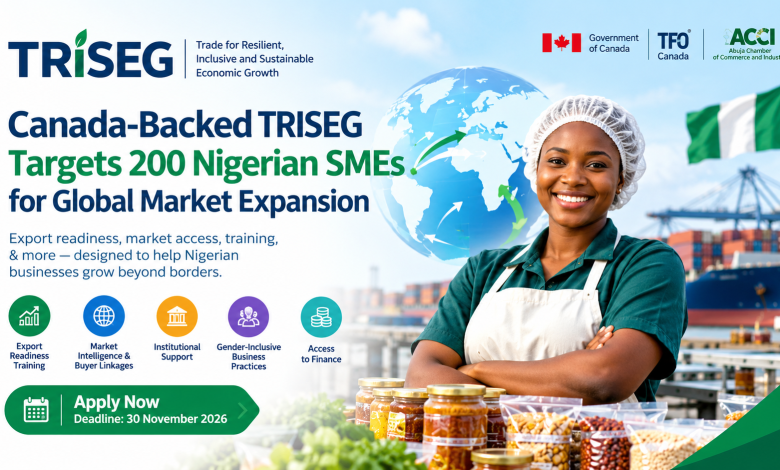
A new international trade initiative funded by the Canadian government is targeting 200 Nigerian small and medium-sized enterprises (SMEs) for support to strengthen their businesses, improve export readiness and access international markets, with women-owned businesses and enterprises led by under-represented groups expected to account for 67 per cent of the Nigerian beneficiaries.
The initiative, known as the Trade for Resilient, Inclusive and Sustainable Economic Growth (TRISEG) project, is a five-year programme funded by the Government of Canada through Global Affairs Canada and implemented by Trade Facilitation Office Canada (TFO Canada) in collaboration with local trade-support institutions.
The Nigerian component was launched in Abuja in October 2026, with the Federal Government, the Abuja Chamber of Commerce and Industry (ACCI) and Canadian representatives among the stakeholders involved in the initiative. The project is designed to strengthen Nigeria’s export ecosystem and help local businesses become more competitive in regional and international markets.
Unlike programmes centred primarily on distributing financial grants, TRISEG focuses on building businesses’ capacity to compete internationally. Its proposed support includes export-development assistance, market intelligence, business coaching, digital strategies and connections with potential buyers in Canada and other international markets.
How TRISEG Could Help Nigerian Businesses
For many Nigerian entrepreneurs, expanding beyond the domestic market involves more than producing a quality product. Businesses must understand international demand, meet the relevant product standards, establish reliable supply chains and navigate export procedures before they can compete effectively abroad.
TRISEG is intended to address some of these barriers by strengthening both the enterprises themselves and the institutions that support them.
According to TFO Canada’s project description, the initiative will help participating businesses improve their export offerings, obtain relevant market information and develop relationships with international buyers.
The programme also aims to strengthen trade-support institutions so they can provide more effective services to small businesses, particularly those owned or led by women and other under-represented groups.
For a Nigerian business seeking to enter a foreign market, this type of assistance could help its owners better understand customer requirements, improve product presentation, identify potential buyers and prepare for international commercial opportunities.

However, participation should not be interpreted as a guarantee of export contracts, overseas sales or business financing. Those outcomes will depend on individual business readiness, market demand and the support actually made available.
Women-Owned Businesses to Receive Particular Attention
One of the programme’s defining objectives is its emphasis on inclusion. Of the 200 Nigerian SMEs targeted, 67 per cent are expected to be owned or led by women and people from under-represented groups, according to reports of the Nigerian launch published by The Guardian and the News Agency of Nigeria.
The emphasis reflects the challenges that smaller businesses can encounter when attempting to expand, including limited access to finance, business-development services, technology, market information and established commercial networks.
By strengthening the support available to these enterprises, TRISEG aims to widen their opportunities to participate in domestic and international trade.
The initiative’s inclusion objective also extends beyond selecting beneficiaries. Its wider design includes strengthening the capacity of trade-support institutions to deliver services that respond more effectively to the needs of women entrepreneurs and other under-represented business owners.
A Five-Year Initiative Covering 16 Countries
Nigeria’s participation forms part of a broader international programme covering 16 developing countries across Africa, Asia, and Latin America and the Caribbean.
According to the official project profile published by Global Affairs Canada, the project has a maximum contribution of C$15.4 million and runs from March 2025 to December 2029.
The programme targets 3,200 SMEs across the participating countries, including 2,133 businesses owned or led by women and under-represented groups. It also aims to strengthen 16 trade-support institutions and improve their ability to deliver inclusive and sustainable business services.
The wider initiative is intended to improve access to Canadian and international markets while encouraging businesses to develop more sustainable and climate-resilient operations.
Its activities include building institutional capacity, improving export-readiness services and helping enterprises develop stronger commercial relationships with potential overseas buyers.
What About Funding and Financial Assistance?
Although access to finance is one of the challenges the initiative seeks to address, entrepreneurs should distinguish between support for accessing finance and a direct cash grant.
TFO Canada’s published description refers to a Climate Resilience Fund intended to support the development of climate-resilience investment plans and facilitate access to capital through partnerships with local financial institutions.
This forms part of the initiative’s broader approach to helping businesses prepare for climate-related risks and develop more resilient operations. It should not be interpreted as confirmation that every participating Nigerian SME will receive a cash payment.
Businesses interested in the initiative should therefore verify the specific benefits, selection criteria and financial arrangements attached to the relevant programme before committing resources or relying on claims made by third parties.
Applications: An Opportunity for Agro-Processing SMEs
A separate announcement published by Chamber Telegraph on October 16, 2026, stated that ACCI, working with TFO Canada under the TRISEG project, had invited eligible Nigerian SMEs in the agro-processing sector to register for a capacity-building programme.
The announcement particularly encouraged women-owned and women-led agro-processing businesses to participate. It also cautioned that registering would not guarantee selection, as applications would be assessed against the programme’s eligibility criteria.
Businesses interested in this opportunity should review the announcement carefully to confirm the applicable requirements and whether registration remains open.
Official programme information: The Government of Canada’s project profile provides details of TRISEG’s funding, duration, participating countries and objectives.
Read the official TRISEG project profile published by Global Affairs Canada.
For the reported agro-processing registration opportunity, consult the ACCI programme announcement published by Chamber Telegraph. The announcement includes the registration link and explains that submission does not guarantee selection. Prospective applicants should confirm the current application status and requirements through the programme’s organisers.
Can TRISEG Translate into More Exports and Jobs?
The significance of TRISEG will ultimately depend on whether the support it provides helps Nigerian businesses overcome practical barriers to international trade.
Improved export preparation and stronger buyer connections could create opportunities for participating enterprises to expand their customer base, increase production and potentially create jobs. However, these are intended outcomes, not results that can yet be assumed.
Challenges involving product certification, testing facilities, logistics, access to finance and compliance with international standards remain important considerations for Nigerian exporters. Reporting on the programme’s launch highlighted calls for stronger regulatory capacity and improved support systems to help businesses meet international market requirements. The Guardian Nigeria
The programme’s implementation will therefore require coordination between businesses, trade-support institutions, regulators and other stakeholders.
For Nigeria’s SMEs, the opportunity is not simply to receive training. It is to build the capacity, market knowledge and commercial relationships needed to compete beyond the domestic economy.
As implementation progresses, the key measures of success will include whether participating businesses become better prepared for export, establish international buyer relationships, enter new markets and achieve sustainable growth.
How to Apply for the TRISEG Programme for Nigerian SMEs
The Trade for Resilient, Inclusive and Sustainable Economic Growth (TRISEG) project is inviting applications from small and medium-sized enterprises (SMEs) operating in the processed food sector to participate in its business development and export-readiness activities.
Who Can Apply?
The current application invitation is specifically directed at SMEs in the processed food sector. Interested businesses should complete the official application form for consideration.
What Benefits Will Selected Businesses Receive?
According to the programme announcement, selected SMEs will have the opportunity to benefit from:
- Export-readiness training and coaching:Practical support to help businesses prepare their products and operations for export markets.
- Market intelligence and buyer linkages:Access to relevant market information and opportunities to connect with potential international buyers.
- Institutional support:Assistance delivered through the project’s business and trade-support institutions.
- Gender-inclusive business training:Tailored training to promote inclusive business practices.
- Improved access to finance:Support aimed at helping businesses improve their access to appropriate financing opportunities.
The project plans to work with 200 selected SMEs in each participating country. However, submitting an application does not guarantee selection.
How to Complete the Application
Interested businesses should follow these steps:
Step 1: Access the official application form
Open the TRISEG application questionnaire using the link below:
CLICK HERE TO APPLY FOR THE TRISEG PROGRAMME
Step 2: Complete Section 1 — Pre-screening Questions
Answer the initial questions used to determine whether your business meets the programme’s preliminary requirements.
Step 3: Complete Section 2 — Export Offerings Assessment
Provide the requested information about your business’s products and export offerings. Ensure your responses accurately represent your products and your business’s current capabilities.
Step 4: Complete Section 3 — Baseline Survey
Answer the survey questions designed to establish baseline information for the project.
Step 5: Review and submit your application
Check your responses carefully before submitting the completed form. The application is expected to take approximately 30–40 minutes to complete.
Application Deadline
Deadline: 30 November 2026
Interested SMEs are encouraged to submit their completed applications on or before the stated deadline.
How Will Applications Be Assessed?
According to the programme announcement, all submissions will be reviewed by Trade Facilitation Office Canada (TFO Canada) and the Abuja Chamber of Commerce and Industry (ACCI) against established eligibility and selection criteria.
Important: Completing the application form does not guarantee selection. Applicants should provide accurate information and ensure that their businesses meet the programme’s applicable requirements.
Official Application Link
Processed food sector SMEs interested in export-readiness training, market intelligence, buyer connections and other business development support can access the application form below.