FG Announces 30-Day Petrol Discount at NNPCL Stations, Prioritises Public Transport Operators
30 Days of Petrol Relief: A Genuine Solution or Just Temporary Breathing Space

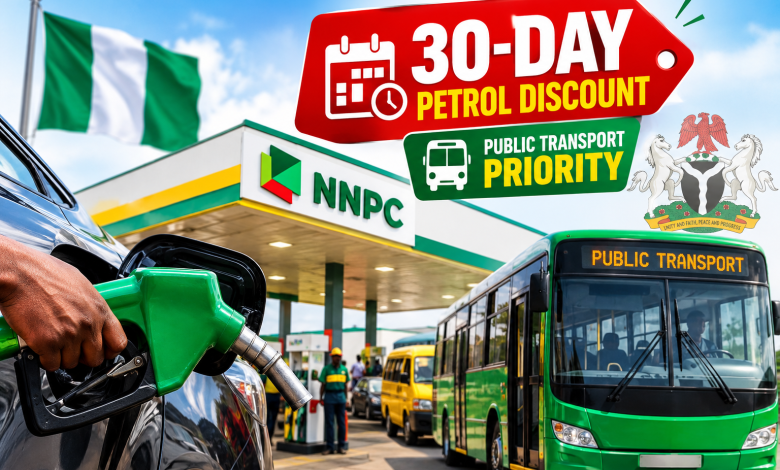
The Federal Government has announced a 30-day petrol discount at filling stations operated by the Nigerian National Petroleum Company Limited (NNPCL), with public transport operators receiving priority under the arrangement as authorities seek to ease the impact of rising fuel prices on Nigerians.
This is coming few days after InsightRegion exclusive analysis on Why Petrol cannot be Sold in Nigeria Same Price as in America or International Market.
The Federal Government says the temporary measure will allow NNPCL to sell petrol at cost, while a proposed ₦1,350-per-litre landing-cost ceiling and other interventions seek to moderate fuel-price volatility.
The Minister of Finance and Coordinating Minister of the Economy, Taiwo Oyedele, announced the measure on Thursday, October 8, 2026, during a press briefing in Abuja on petrol prices and government interventions. The Presidency subsequently confirmed that NNPC Retail had agreed to forgo its retail profit margin and sell petrol at cost during the initial 30-day period.
According to the Federal Government, the intervention is intended to provide temporary relief to households and transport operators facing increasing energy and transportation costs without reinstating the former nationwide petrol subsidy regime.
“We are offering a discount on petrol dispensed by NNPC Limited for the next 30 days in the first instance, with priority for public transporters nationwide,” Oyedele said, explaining that the arrangement would involve selling petrol at cost rather than restoring the previous subsidy system.
How the 30-day petrol discount will work
Under the arrangement announced by the government, NNPC Retail will surrender the profit margin it would ordinarily earn from petrol sales and offer the product at its landing cost during the 30-day window.
The Presidency explained that if NNPC’s landing cost for petrol is ₦1,300 per litre, the company would sell it at that price rather than add its usual retail profit margin.
This means the amount customers pay will depend on the applicable cost of the product. The announcement does not establish a single fixed pump price for every NNPCL station across the country.




The government has also indicated that commercial vehicles and other public transport operators will receive priority, reflecting its intention to target the intervention at an important source of pressure on household budgets.
However, the exact discount per litre, the detailed process for identifying eligible transport operators and the arrangements for monitoring sales have not been fully spelt out in the published announcement. These details will be important in determining how accessible the intervention will be to intended beneficiaries.
Why public transport operators are being prioritised
The decision to prioritise public transport operators reflects the connection between petrol prices, transportation fares and the cost of living.
When fuel becomes more expensive, commercial bus operators, taxi drivers and other petrol-dependent transport businesses face higher operating costs. These expenses can be passed on to passengers through increased fares.
Higher transport costs also affect traders, farmers, manufacturers and distributors who depend on vehicles to move people, food and other goods between communities and markets.
By allowing NNPCL to sell petrol at cost, the government hopes to reduce the fuel expenses of transport operators and encourage lower transportation and logistics costs.
The intended benefit could extend beyond passengers who travel daily to work, school, markets and other destinations. If transport costs decline, businesses may also experience some relief in the cost of moving goods, potentially moderating pressure on the prices of essential commodities.
Nevertheless, cheaper petrol for transport operators will not automatically translate into cheaper fares. The impact will depend on the amount saved per litre, the volume of fuel purchased, operators’ other expenses and whether they pass the savings on to passengers.
Petroleum economist and Professor Emeritus of Petroleum Economics, Wumi Iledare, told The Guardian that the intervention would need a measurable mechanism to ensure that lower fuel costs translate into lower fares. He warned that passengers could miss out on the intended benefits if transport operators received cheaper petrol but continued charging the same fares.
Government proposes ₦1,350 ceiling on petrol landing costs
Alongside the temporary discount, the Federal Government has announced a separate proposal to negotiate a ceiling of ₦1,350 per litre on the ex-gantry or landing cost of petrol.
The proposal is designed to moderate the impact of fluctuations in international crude oil prices and foreign exchange rates on the cost of petrol in Nigeria.
Under the proposed price-modulation arrangement, refiners and importers would initially bear costs that exceed the agreed ceiling and recover the difference later when market conditions become more favourable.
The government says the arrangement would be reviewed monthly, with the relevant figures published to promote transparency.
Oyedele has maintained that the proposed ceiling is neither a return to petrol subsidy nor a conventional price-control policy. Instead, the government describes it as a mechanism for smoothing out sharp price movements over time.
Importantly, the proposed ₦1,350 figure relates to the ex-gantry or landing cost of petrol, not necessarily the final retail price motorists will pay at filling stations. Distribution, transportation, retail and other applicable costs mean that the pump price can differ from the landing cost.
The distinction is significant because the announcement should not be interpreted as a guarantee that petrol will sell for ₦1,350 per litre nationwide.
Government insists the measure is not a return to subsidy
The Federal Government has repeatedly rejected suggestions that the 30-day discount represents a reversal of the petrol subsidy removal announced by President Bola Tinubu on May 29, 2023.
Under the new arrangement, the Presidency says NNPC Retail will forgo its retail profit margin rather than operate a blanket subsidy covering petrol consumption nationwide.
The distinction is central to the government’s position. Instead of subsidising petrol for all consumers, the intervention is presented as a temporary concession through a government-owned company’s retail operations.
However, the economic implications will depend on how the arrangement is financed, how much revenue NNPCL gives up, the quantity of petrol sold under the scheme and the extent to which consumers benefit.
Chief Executive Officer of the Centre for the Promotion of Private Enterprise, Muda Yusuf, described the arrangement as a form of subsidy, although one that differs from the previous blanket system because it is restricted to NNPCL stations.
Other economic stakeholders have also called for greater disclosure of the discount per litre, the volume of petrol covered, the financial exposure involved and the results recorded at the end of the 30 days.
These concerns highlight an important distinction: the government may classify the arrangement as a margin concession rather than a subsidy, but its practical impact will be judged by its cost, transparency and benefits to consumers.
Other measures announced to address fuel-price pressure
The 30-day petrol discount forms part of a wider package of measures announced by the Federal Government to reduce the impact of energy costs and improve economic stability.
According to the Presidency, the measures include plans to introduce forward sales of crude oil to domestic refineries. The government expects the arrangement to help protect local refining and petrol prices from some of the effects of fluctuations in the international oil market.
The administration is also pursuing an expanded compressed natural gas (CNG) programme in collaboration with state governments. It expects greater use of CNG in transportation to lower operating costs and encourage transport operators to reduce fares.
Other announced measures include increased funding for cash transfers to vulnerable households, subsidised credit for small businesses and consumers, and efforts to curb road taxes and levies that increase transport and logistics costs.
The government has further announced plans for a National Strategic Fuel Reserve, through which refined products could be released under specified rules during major supply disruptions or periods of hoarding.
It also said it would consider an excess-profit tax on operators found to be taking undue advantage of consumers along the energy value chain, with the proceeds intended to support vulnerable groups.
The Presidency says these interventions are designed to provide targeted relief without restoring a blanket petrol subsidy.
Labour and opposition figures question the impact
The announcement has attracted criticism from labour organisations and opposition political groups, several of which argue that a 30-day discount may be insufficient to address the wider cost-of-living crisis.
The Nigeria Labour Congress called for a much deeper reduction in petrol prices, with Assistant General Secretary Chris Onyeka arguing that a ₦1,350 benchmark would not provide meaningful relief to workers.
The Association of Senior Civil Servants of Nigeria also questioned whether the intervention would be sufficient to cushion the impact of high petrol prices, urging the government to use the period to address structural problems in the petroleum sector.
The Federation of Informal Workers Organisations of Nigeria described the intervention as inadequate, pointing to the limited effect that a relatively small reduction in fuel costs could have on households already facing high transportation, food and energy expenses.
Opposition figures, including former Vice-President Atiku Abubakar, have similarly questioned the measure’s duration and its capacity to provide lasting relief. The Obidient Movement, the Nigeria Democratic Congress and the presidential campaign organisation associated with Oyo State Governor Seyi Makinde have also criticised the intervention.
Their central argument is that temporary relief does not resolve the underlying problems associated with high fuel prices, rising transport fares and declining purchasing power.
The criticisms represent the views of the respective organisations and political figures; the ultimate impact of the intervention will depend on its implementation and measurable results.
Concerns over access and implementation
Another important question is whether the intervention will be accessible to enough transport operators and households to produce a nationwide effect.
Because the discount is being offered through NNPCL retail outlets, its immediate reach will depend on the availability of those stations, the volume of petrol supplied and the ability of eligible operators to access the discounted product.
In its report on the announcement, The Guardian cited figures indicating that NNPCL outlets account for only a small proportion of registered filling stations nationwide. This raises questions about whether operators in communities without convenient access to NNPCL stations will benefit equally.
The Petroleum Products Retail Outlets Owners Association of Nigeria (PETROAN) has asked the government to consider allocating 30 per cent of the petrol covered by the scheme through its members’ retail network. The association argues that wider distribution could extend the intervention to rural and underserved communities.
The government will also need to clarify how priority for public transport operators will work in practice, how the discount will be reflected in pump prices and how compliance will be monitored.
Without clear guidelines and effective oversight, the benefits could be unevenly distributed or fail to reach the passengers and households the intervention is intended to support.
What Nigerians should expect over the next 30 days
For motorists and transport operators, the immediate question is how much cheaper petrol will become at participating NNPCL stations compared with the prices otherwise charged.
For commuters, the more important test is whether the intervention leads to lower fares on commercial buses, taxis and other public transport services.
For traders and businesses, the potential benefit will depend on whether savings in fuel and logistics costs are reflected in the prices of goods and services.
The 30-day period will therefore provide an opportunity to assess whether the intervention can produce measurable relief rather than simply lower the operating costs of selected fuel buyers.
To establish its effectiveness, the government should publish the actual discount per litre, the volume sold, the number and distribution of beneficiaries, the financial implications for NNPCL and evidence of changes in transportation fares.
It should also explain what happens when the initial 30-day period expires, including whether the scheme will end, be extended or be replaced by another intervention.
These questions matter because households and businesses need predictable costs, not just short-term reductions that disappear without a sustainable alternative.
A temporary intervention with a wider economic test
The Federal Government’s decision to offer petrol at cost through NNPCL for 30 days is an attempt to provide targeted relief while maintaining its position that the former blanket subsidy should not be restored.
Prioritising public transport operators could be a practical way to reach a broad section of the population, particularly if lower fuel expenses translate into reduced fares and distribution costs.
However, the success of the initiative will depend on more than the announcement itself. Access to participating stations, transparent pricing, adequate supply, effective monitoring and the transmission of savings to passengers will determine whether Nigerians experience meaningful relief.
The proposed ₦1,350 landing-cost ceiling and other measures may also influence the outlook for fuel prices, but their effectiveness will depend on how they are implemented and sustained.
Ultimately, the key measure of success will not be whether NNPCL sells petrol at a discount for one month. It will be whether the intervention reduces the financial pressure on commuters, workers, households and businesses—and whether the government can prevent a return to the same hardship when the 30 days are over.