FG Launches Digital Postcode System: How Nigeria’s New 11-Character Addressing System Works
Nigeria has launched a national digital postcode system giving addressable buildings unique 11-character codes. Here’s how it works and what it means for deliveries, emergencies, businesses and public services

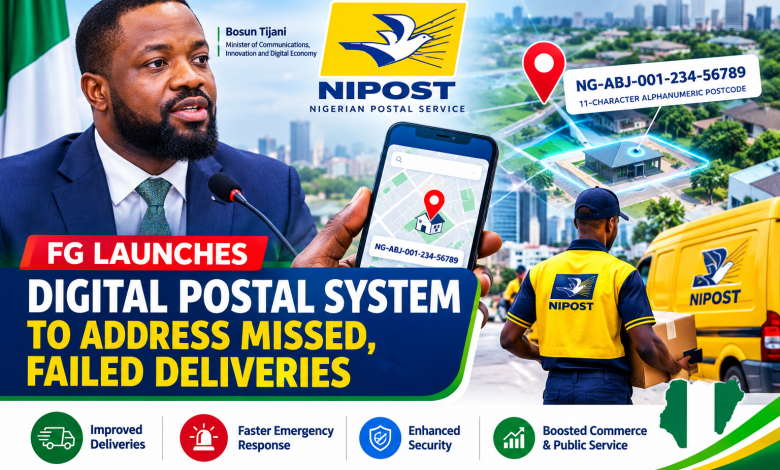
Nigeria has launched a new national digital addressing system that gives addressable buildings unique 11-character codes, with the Federal Government expecting it to improve deliveries, emergency response, commerce, security and public-service delivery.
Imagine ordering something online and, instead of spending several minutes explaining to a delivery rider that your house is “after the filling station, beside the blue gate, close to the old market,” you simply provide a code that points to the exact building.
That is the problem Nigeria’s new National Digital Alphanumeric Postcode System is designed to help solve.
The Federal Government officially launched the system on October 1, 2026, through the Nigerian Postal Service (NIPOST). According to the Federal Ministry of Communications, Innovation & Digital Economy, the system gives addressable buildings across Nigeria a unique, precise and verifiable digital location identity.
The initiative is being presented as much more than a way to make postal deliveries easier. It is intended to provide a common digital reference for physical locations that can be used by businesses, logistics companies, emergency services, financial institutions and government agencies.
Why Nigeria Is Introducing a New Digital Postcode
Finding a Nigerian address can sometimes require more than knowing a street name and house number.
A person may have to provide a landmark, junction, estate name, nearby business or a detailed verbal description before a visitor, delivery rider or emergency responder can locate the right building. That creates a problem for digital systems.
People can interpret descriptions such as “opposite the old market” or “beside the blue gate,” but software needs a more structured way of identifying a physical location.
The Federal Government says the new Digital Postcode is intended to provide that missing location layer.




The Ministry has described it as part of Nigeria’s broader Digital Public Infrastructure, with potential applications extending beyond postal services to logistics, e-commerce, emergency response, national planning, public safety and government service delivery.
The government has also said poor addressing contributes to missed and failed deliveries and creates wider challenges for businesses, emergency services and public institutions. Channels Television, reporting the launch, quoted the minister as putting Nigeria’s estimated annual losses from missed and failed deliveries at between ₦50 billion and ₦80 billion.
So, What Exactly Is Nigeria’s New Digital Postcode?
The Digital Postcode is an 11-character alphanumeric code assigned to an addressable building or location.
“Alphanumeric” is important because the code contains both letters and numbers.
The official NIPOST platform describes the system as a GIS-linked digital reference for identifying buildings and their locations across Nigeria.
In simple terms, instead of relying only on a written description of where a building is, the Digital Postcode gives that physical location a standardized code that can be identified digitally.
The system is structured through five geographic levels:
State → LGA → District → Area → Building
The official platform illustrates the structure using components such as FC, 02, A09, DB and 09, with the different sections narrowing the location from a wider geographic area down to the building.
That means the system is designed to move from the broadest location information to the specific building being identified.
It Is the Building That Gets the Postcode — Not the Person
One of the most important things Nigerians need to understand is that the Digital Postcode belongs to the building, not the person living or working there.
If a tenant moves out of a house, the building’s postcode does not change simply because the occupant has changed. If another family moves into the same building, they can use the same postcode.
Similarly, several people or organisations using the same building can share its postcode because the code identifies the physical location rather than an individual.
This distinction could become particularly important as businesses, banks, online platforms and government services begin using digital location information.
Does the Digital Postcode Replace Your Address?
No.
This is another important distinction. The Digital Postcode is not intended to eliminate the conventional address that Nigerians already use.
Instead, it provides a standardized digital reference that can be used alongside the written address.
NIPOST’s official FAQ explains that a conventional address describes where a building is located, while the Digital Postcode provides an 11-character location reference for that building.
So a delivery address could still contain the recipient’s name, house number, street, area and city, while the Digital Postcode provides an additional standardized reference for the actual building.
How Could It Improve Deliveries?
This is where ordinary Nigerians are likely to notice the system first.
Consider a typical online purchase.
A customer enters an address, adds an estate name and perhaps includes instructions such as:
“Turn after the filling station, then ask for the house with the black gate.”
The delivery rider then has to interpret those instructions and find the right building.
NIPOST’s new system is designed to reduce that uncertainty by giving the building a fixed digital reference.
According to the official postcode platform, the code can be used to identify and share a location, while businesses and logistics organisations can integrate Digital Postcode into their systems.
That could eventually make it easier for:
- E-commerce companies to collect precise delivery locations;
- Logistics firms to verify destinations;
- Delivery riders to locate customersBusinesses to maintain more consistent customer addresses;
- Customers to share their exact building location; and
- Online platforms to connect written addresses with a standardized location reference.
The important point is that the Digital Postcode does not necessarily eliminate the need for directions at the final stage of a journey. Rather, it gives the delivery process a more reliable starting point for identifying the correct building.
Why Emergency Services Could Benefit
The implications go beyond packages. Consider an emergency in which a family needs an ambulance but cannot provide a conventional address that clearly identifies the building.
A location reference that can be digitally identified could potentially make it easier for emergency responders to determine where assistance is required.
This is one reason the Federal Government has emphasized the system’s potential role in emergency response and public safety.
At a June 2026 national workshop on operationalising the Digital Postcode, government agencies and security and emergency-response institutions examined how the system could be integrated into policing, intelligence gathering, emergency response, border management, critical infrastructure protection and public safety.
Minister Bosun Tijani has also used the question “Where?” to explain the wider importance of the initiative.
The underlying idea is straightforward: Before government, emergency services or a business can effectively reach a person, facility or community, they need to know where it is.
What Could It Mean for Businesses?
Businesses may become some of the biggest users of the new system if adoption grows.
A company that delivers products across different cities needs more than a customer’s description of a location. It needs a consistent way to identify the destination.
The Digital Postcode could potentially help businesses with:
- E-commerce: Customers could provide a standardized location reference during checkout.
- Logistics: Dispatch systems could use postcode information when assigning and tracking deliveries.
- Customer verification: Businesses could use location information to help confirm customer or merchant addresses.
- Field services: Companies sending technicians or service workers could use a standardized building reference.
- Property and asset management: Physical facilities and assets could be associated with specific locations.
NIPOST says organisations can integrate Digital Postcode into their applications, platforms and workflows through available integration options, including APIs, web and mobile SDKs and bulk access.
That means the long-term importance of the project could depend heavily on whether private companies actually integrate it into the services Nigerians use every day.
What Could It Mean for Government Services?
The potential government applications are even broader. A reliable national location layer could help agencies identify where public facilities, infrastructure and communities are located.
The Federal Ministry has identified possible applications in areas including national planning, emergency response, public safety, logistics and government service delivery.
For example, accurate location information could potentially help government agencies determine:
- Where a public facility is located;
- Where emergency assistance is required;
- Where infrastructure is being delivered;
- Where government services should be directed;
- Where a particular business or facility operates; and
- How different agencies can refer to the same physical location.
The bigger ambition, therefore, is to create a common digital location layer that different systems can understand.
How Nigerians Can Find Their Digital Postcode
NIPOST says Nigerians can find their Digital Postcodes through the official Digital Postcode website or app.
There are two main approaches.
Visit the NIPOST Digital Postcode Portal https://postcode.gov.ng
Then,
1. Search for the location
If you know the address, you can search for the location through the platform and identify the relevant building.
2. Use your current location
If you are at or near the building, you can allow the platform to use your location and identify the building on the map.
NIPOST’s official guide recommends carefully checking the building shown on the map before accepting its postcode. This is particularly important in areas where several buildings are close together.
Once the correct building has been identified, the platform displays its 11-character postcode. The postcode can then be saved and shared with other people or organisations.
What If Your Building Does Not Have a Postcode?
The government is also providing a mechanism for cases where a building cannot be found or its information needs correction.
According to NIPOST, users can request a postcode through the official website or app by providing location information, including their address or a Google Maps link where necessary. The request can then be reviewed and a postcode assigned.
Users can also suggest corrections when information about a building is incorrect.
This is important because the success of a national digital addressing system depends not only on creating codes but also on keeping the underlying location information accurate.
The Digital Postcode Is Not Google Maps
Another possible misconception is that Nigeria has simply created another mapping service. That is not the case.
NIPOST specifically states that Digital Postcode does not replace Google Maps or other mapping services.
Instead, the postcode provides a standardized way of identifying a building, while mapping services can continue to provide navigation and directions.
In practical terms:
Digital Postcode = identifying the building
Mapping/navigation service = helping you get there
The two can therefore work together.
What Will Determine Whether the System Succeeds?
Launching the technology is only the first step. The bigger test will be whether Nigerians, businesses and government agencies actually adopt it.
The Federal Government has already acknowledged the importance of integration. At the June 2026 workshop, officials discussed interoperability, data governance, institutional adoption and practical implementation across government systems.
Several questions will therefore matter over time.
Will Nigerians use their postcodes?
People need to know their codes and start including them when sharing locations.
Will businesses integrate them?
The system becomes significantly more useful if banks, fintechs, e-commerce platforms, logistics companies, property businesses and other services incorporate it into their systems.
Will the information remain accurate?
Buildings change, new structures are constructed and information can sometimes be incorrect. A digital addressing system needs mechanisms for updating and correcting its database.
Will it work consistently across Nigeria?
The system is designed for addressable buildings in both urban and rural communities, but its real-world effectiveness will ultimately be measured by coverage, accuracy and adoption across different parts of the country.
Will different institutions use the same location language?
This may be one of the most important tests.
The greater the number of government agencies and private organisations that recognize the same Digital Postcode, the more valuable the system becomes.
What Changes for the Average Nigerian?
For an ordinary resident, the immediate change may be quite simple. Instead of repeatedly explaining where your home or business is, you can have a standardized digital reference for the building.
You could use it when:
- Ordering goods online;
- Receiving courier deliveries;
- Sharing your location with someone;
- Giving an address to a business;
- Providing a location for a service appointment;
- Helping someone find your home or office; or
- Giving a more precise location during an emergency.
NIPOST says individuals can find, save and share Digital Postcodes for free.
The Bigger Picture
Nigeria’s new Digital Postcode System may look like a solution to a familiar problem—failed deliveries—but its ambition is considerably larger.
The Federal Government is attempting to give the country’s physical locations a standardized digital identity.
If widely adopted, that could create a common reference point connecting people, buildings, businesses, logistics systems, emergency services and government institutions.
But technology alone will not determine the outcome.
The real test will be whether the postcode becomes part of everyday Nigerian life and whether businesses and public institutions build it into the systems through which Nigerians receive services.
For now, the message from government is simple:
Know where you are. Know the digital code for your building. And start using it.
Because, as the minister put it when explaining the purpose of the initiative:
“For a country to work efficiently, we need to be able to answer one very basic question. Where?”
That question may be simple.
Building a system capable of answering it accurately for an entire country is the much bigger task.